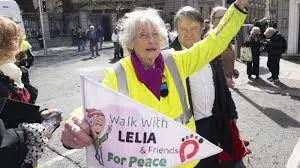
At the gates of parliament in Dublin, Lelia Doolan finished a 220km walk with supporters around her, tired but steady after two weeks on the road. The 91-year-old peace activist used the journey to press one message: the use of Shannon Airport by US military flights should end. For Lelia Doolan, the protest was not only about an airport. It was about neutrality, responsibility, and what she sees as a promise Ireland has failed to keep.
What did Lelia Doolan’s protest walk represent?
The walk began at Shannon Airport on 31 March and ended in Dublin at Leinster House, where crowds greeted her with hugs, cheers, Palestinian flags, and opposition politicians. Along the way, supporters joined her for sections of the route, while others stood in gardens and roadside spots to wave her on. She passed through places including Limerick, Nenagh, Roscrea, Portlaoise, Newbridge, Naas, and other stops before reaching the capital.
Lelia Doolan framed the march as a peaceful appeal to the government to bar US military flights from using Shannon. She said the airport is civilian, not military, and argued that allowing the flights violated Irish neutrality. Her words were direct: people had been “fooled” into thinking the practice had to continue, and “It doesn’t have to continue. ”
Why has Shannon Airport become part of this wider argument?
The dispute over Shannon has lasted for decades, with activists repeatedly objecting to the arrangement that allows US military aircraft to refuel there. In the current debate, the government says the airport is not used in US combat operations and that there is no evidence weapons or supplies for US attacks enter Irish airspace. Doolan rejected that framing, saying US military planes were landing without agreement to search them or check what was inside.
The issue has also taken on renewed force amid the conflict in the Middle East. That tension was visible during the walk and at the finish, where Palestinian flags were prominent and the crowd joined in protest songs. In that setting, Lelia Doolan’s march became more than a personal statement; it reflected a broader campaign linking neutrality, war, and public accountability.
Who joined her, and what did political leaders say?
Supporters accompanied Doolan during the journey and at the gates of parliament, where she arrived at noon on Wednesday after a fortnight of walking. She said she wanted to honor Irish neutrality and felt a duty to speak out against the movement of US military personnel through Ireland. She also paid tribute to the people she met on the way, praising them as “wonderful, ” “engaging, ” “decent” and “intelligent. ”
In the Dáil, Ivana Bacik, leader of the Labour party, praised Doolan and urged the government to stop allowing US military planes to use Shannon. Taoiseach Micheál Martin said he respected Doolan and would try to meet her, but maintained that the airport had no role in the Middle East conflict. He also said, “Shannon airport is not a US military base. ”
What happens now after Lelia Doolan’s walk?
The immediate answer is political, not symbolic. Doolan urged politicians to use existing laws to bar US military planes from Shannon and called on Ireland to tell its US friends the truth. She described the demonstration as one rooted in equality, kindness, goodness, decency, and honor, and argued that honesty should guide the response.
Her campaign did not end with the final step in Dublin. It ended with a question that remains open: whether the government will treat the march as a passing act of protest, or as pressure to reconsider a long-standing policy that Lelia Doolan says runs against Irish neutrality. As she stood outside Leinster House, the scene carried both weight and simplicity — a 91-year-old woman, a long road behind her, and a demand that had not yet been answered.