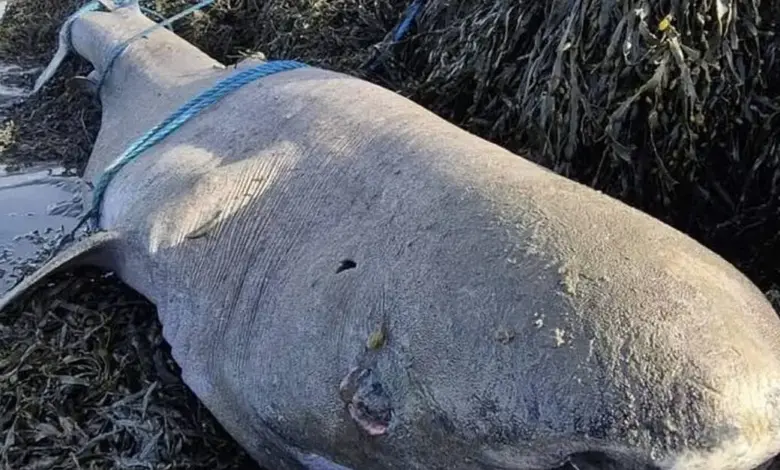
A rare greenland shark has drawn unusual attention to the Sligo coast after a member of the public first believed they had found a dead basking shark. The photos told a different story. What followed was not just a striking stranding, but a transfer to the National Museum of Ireland for dissection and research. In a marine landscape where such encounters are exceptional, the find has immediately become more than a curiosity: it is a chance to learn something new about a species that remains deeply obscure.
A Rare Find on the North West Coast
The Irish Whale and Dolphin Group said it received the report on Saturday through its hotline. After the images were reviewed, the animal was identified as a greenland shark rather than the species initially suspected. The group described the stranding as “very rare and interesting, ” underscoring how unusual it is to encounter this deep-sea shark in Irish waters.
The shark was found on the Sligo coast and is now in the possession of the National Museum of Ireland for dissection and research. That step matters because strandings like this can provide a rare physical record of an animal that is otherwise seen only infrequently, if at all, near the surface.
What the Measurements Suggest
The shark was identified as male and measured 2. 87 metres in length. It had developed claspers, and the Irish Whale and Dolphin Group estimated that it was on “the brink of maturity. ” On that basis, the animal could have been around 150 years old. That estimate is striking, but it also reflects the extraordinary biology attached to this species. The greenland shark has the longest known lifespan of all vertebrate species, with some individuals living up to 500 years.
That combination of size, age, and late maturity helps explain why the species is so difficult to study. If maturity comes only after roughly a century and a half, then every specimen carries a large amount of ecological and biological history. In practical terms, each finding can offer researchers a rare window into growth, reproduction, and survival in deep-water environments.
Why the Species Matters Scientifically
Little is known about the greenland shark because its natural habitat is deep in the North Atlantic and Arctic Oceans. The species is a large breed, and the largest recorded individual reached 6. 5 metres and weighed more than 1, 000 kilograms. Females have a gestation period of between eight and 18 years, another sign of how slow the species’ life cycle can be.
The animal’s eyes can also be affected by parasites, leaving many sharks blind, but they are still able to hunt in dark waters. That detail helps show why the species has remained so elusive: it is adapted to an environment that is difficult to access and even harder to observe directly. For researchers, the Sligo specimen may therefore be valuable not only because it is rare, but because it arrives with a set of biological clues that can be examined closely.
Expert and Institutional Significance
In the context of this stranding, the clearest expert judgment comes from the Irish Whale and Dolphin Group, which said the discovery was a “very rare and interesting stranding. ” That assessment is important because it reflects both the scarcity of such events and the limited opportunity to examine the species in Irish waters.
The National Museum of Ireland’s involvement adds another layer of significance. By taking the shark for dissection and research, the institution can help document a species that experts say is rarely encountered off the North West coast. The value here is not only in identification, but in the chance to expand knowledge of a shark whose habits, lifespan, and reproductive timing all point to a slow-moving life history that is unlike most marine animals.
What It Means for Ireland and Beyond
For Ireland, the strandings of a deep-sea shark on the Sligo coast highlight how little is still understood about species that live far below the surface. The find may help fill small but important gaps in knowledge, especially because it comes from an area where the species is rarely seen. The broader significance is global: when a greenland shark surfaces in this way, it gives scientists a chance to study one of the ocean’s most unusual vertebrates without having to rely solely on scattered sightings.
That is why this case matters beyond the shoreline itself. A single stranding cannot explain the species, but it can sharpen the questions researchers ask about age, maturity, movement, and survival in cold, deep waters. If one rare encounter can reveal this much, what else might remain hidden in the depths?