The word flip has become central to Virginia’s redistricting fight, but not in the way either side wants. As early voting continues ahead of the April 21 special election, the debate has shifted from map lines to identity, with Fairfax County cast as both a symbol of political power and a target of rural resentment. What is at stake is not just one referendum, but whether voters will approve a plan that could turn Virginia’s current 6-5 congressional split into something far more lopsided.
Why Fairfax County Became the Symbol
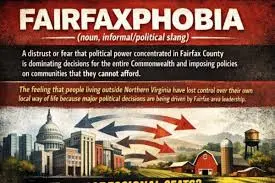
In the messaging opposing the initiative, Fairfax County has started to function almost like a verb. Signs reading “Don’t Fairfax Me” and “Vote No” have appeared in rural parts of the state, while Del. Wren Williams has used the term “Fairfaxphobia” to describe what he says is a fear of political power concentrated in the county. The campaign’s language suggests that the referendum is being sold not only as a map fight, but as a contest over whose version of Virginia should define the commonwealth.
Williams said he worries that the proposed map would split Fairfax County across at least five districts and could eventually produce five sitting congressional members from the county. His argument is that such an outcome would not reflect the entirety of Virginia. Supporters of the referendum are making a different case: they say the proposal is a response to President Donald Trump’s push for redistricting in Republican-led states. That framing places Virginia’s vote inside a broader partisan tug-of-war, even as the local argument remains rooted in geography and representation.
What the Map Could Change
The numbers are what make this referendum unusually high-stakes. Virginia currently sends six Democrats and five Republicans to the U. S. House across 11 districts. Experts say the proposed map could give Democrats a 10-1 advantage. That would be a dramatic shift, and it explains why the campaign has become so combative before voters have even reached the ballot box.
The use of the term flip is therefore more than a political slogan. It captures the possibility that a single vote could reshape congressional representation at a scale that would echo far beyond Virginia. Yet the messaging on the ground shows that many voters are not debating abstract institutional design. They are reacting to whether a map that centers Fairfax County feels fair to rural communities that already believe their influence is shrinking.
Political Messaging, Money and Confusion
The “Don’t Fairfax Me” signs are paid for and authorized by a political action committee called New Vision VA. Dominion Energy made a $25, 000 donation to the PAC, adding another layer to a campaign already defined by suspicion and competing narratives. On the ground, some residents say the advertising is muddying the issue rather than clarifying it.
Yves Fischer, who lives in Alexandria, said the messaging and advertising on the redistricting referendum are confusing. Tiffany framed the language more bluntly, saying the signs suggest that “we are a much more educated, classy, professional, employed area” and therefore are expected to vote yes. Ann, speaking in Springfield, said she had not seen or heard about the signs but believes the proposal “should be a big ‘no’” because “it’s not right” and “it’s not fair to most Virginians. ” Those reactions point to a campaign that is less about technical district design than about competing claims of legitimacy.
Expert Framing and the Wider Stakes
Senate Majority Leader Scott Surovell argued that the backlash misses the larger contribution of Fairfax County to the state’s fortunes. He said, “Fairfax County does a lot for the entire state. If it wasn’t for Fairfax, our state would have the economy of Mississippi. ” His comment underscores the central divide in the debate: whether Fairfax should be seen as a burden on the state’s political balance or as one of its primary engines of strength.
That tension is why the referendum’s outcome matters beyond the special election itself. If voters approve the plan, Democrats could gain a map that gives them the advantage they are seeking. If they reject it, the current 6-5 split remains in place, and the anti-redistricting campaign can claim it protected the state from what it sees as an overconcentration of power. Either way, the fight has already revealed how deeply place, class and political identity are intertwined in Virginia.
Regional and National Implications
Because the debate is tied to broader redistricting battles elsewhere, the result will likely be watched as a test of how far partisan map-making can go before voters push back. The national context matters, but the local response may matter more. In Virginia, the campaign has turned Fairfax County into shorthand for a much larger anxiety: who gets to decide for whom.
That is why this flip vote has become so combustible. It is not only about district boundaries or partisan advantage; it is about whether a dense, influential county can be presented as the face of the state without triggering a backlash from communities that feel left out of power. As April 21 approaches, one question hangs over the race: will voters see the plan as a correction, or as a warning sign?