The new england patriots are just over a week from being on the clock at No. 31, and the most revealing part of their draft picture is not a locked-in answer but a choice between competing timelines. One path points to immediate help on offense; another points to a player who may not start right away but could shape the future of the line.
Verified fact: Patriots executive vice president of player personnel Eliot Wolf said the scouting department is making final tweaks to the draft board, and the team has discussed needs across the offensive line, edge, receiver, and tight end. Informed analysis: that mix suggests the team is not drafting for one position alone, but for a roster build that has to support Drake Maye while planning beyond the next season.
What is the Patriots’ draft board really signaling?
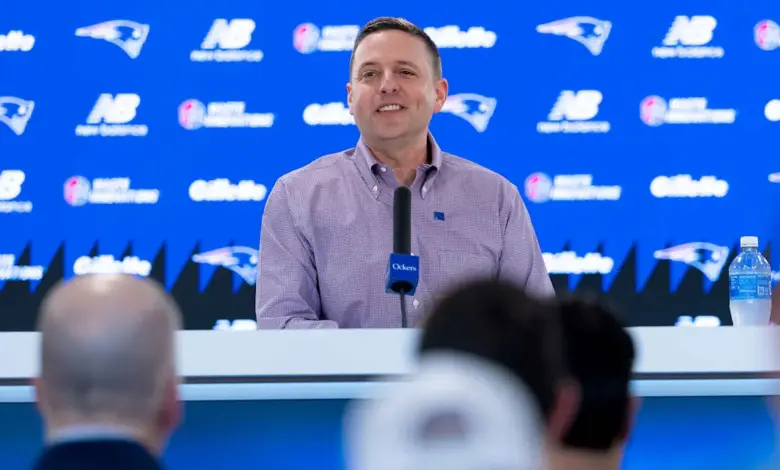
Wolf’s pre-draft press conference set out the framework. He described this class as strong in the trenches on both sides of the ball, with receiver and tight end also grading better than in some recent years. He also said the secondary may not be as strong. That matters because the Patriots are weighing several options with the 31st pick rather than chasing only one obvious need.
On the offensive line, the picture is especially telling. Morgan Moses is expected to play next season, but the team has also been linked to drafting a possible successor at right tackle. Blake Miller of Clemson was identified as a projected first-round possibility with immediate starter upside in one evaluation, while other tackle names were framed as later developmental options. That is the first clear sign of the team’s balancing act: protect now, prepare later.
Why would Blake Miller fit a team looking for stability?
One draft projection had the Patriots selecting Blake Miller at No. 31, calling him the draft’s “iron-man prospect” because of his 54 starts over the last four seasons. The same evaluation connected that durability to head coach Mike Vrabel, who would value the reliability of a player who has been on the field so often.
The case for Miller is not just availability. The idea is that he could spend a season learning from Moses and then step into a larger role afterward. The long-range view is obvious: a future pairing of Will Campbell on the left and Miller on the right could give the new england patriots two young tackles for years to come. That possibility does not guarantee an immediate payoff, but it does explain why a team in need of offense might still prioritize a tackle who is more about continuity than flash.
Verified fact: the draft board discussion also included the possibility that the Patriots seek a player who can contribute this season, such as a wide receiver or pass rusher. Informed analysis: if the team chooses Miller, it would be choosing structure over urgency at a position where both matter.
Could the Patriots still lean edge rusher or tight end instead?
The other major lane runs through the defensive front. The Patriots’ first-round pick was described as most likely to go toward an edge rusher, and one fit presented was a player with a different skill set from Dre’Mont Jones, who joined in free agency. Jones was identified as a bigger edge player who excels against the run, while the suggested target would bring a higher pass-rush ceiling and could potentially supplant Harold Landry as a starter.
That distinction is important because it shows how the Patriots may be trying to avoid redundancy. The idea is not simply to add another body, but to add a specific type of disruption that the current group lacks on the edge.
Tight end is another area where the board appears to be moving. Hunter Henry has one year left on his contract, and Julian Hill was signed to a three-year deal as a blocker. That setup leaves room for a more natural pass catcher. Vanderbilt’s Eli Stowers was presented as a Day 2 option who fits that description, with explosive receiving traits and mismatch potential, though he would need to prove himself as a blocker at the NFL level.
Verified fact: Wolf said the Patriots have a brand new draft room and that the technology has made work easier. Informed analysis: the infrastructure may be new, but the football question remains old and difficult: which hole should be filled first when multiple positions could use help?
Who benefits most from the way this draft is being framed?
The clearest beneficiary is the quarterback. Wolf’s comments and the draft fits discussed around the team all point back to the same reality: as long as Drake Maye is the quarterback, the Patriots can never devote too many resources to the offensive line. That is why a tackle like Miller can be framed as both a present-day learning project and a future starter.
But the team’s own discussion also benefits flexibility. A first-round edge rusher could bring speed and pass-rush pressure. A Day 2 tight end could create mismatches in 12 personnel. A tackle could stabilize the right side for the long haul. In other words, the Patriots are not boxed into one answer; they are building a set of answers and waiting to see which one the board allows.
The larger takeaway is that the Patriots’ draft strategy appears designed to solve for both urgency and durability. Miller’s 54 starts make him attractive as a steady presence. An edge rusher could address a different kind of need. A tight end could offer immediate variety in the passing game. Each choice serves a different timeline, and that is what makes the decision so revealing.
In the final stretch before the draft, the new england patriots are showing that the most important question may not be which position they like best, but which version of their offense and front seven they want to build first. The answer will say whether this draft is about fixing a weakness, or about setting a foundation that can hold for several seasons.