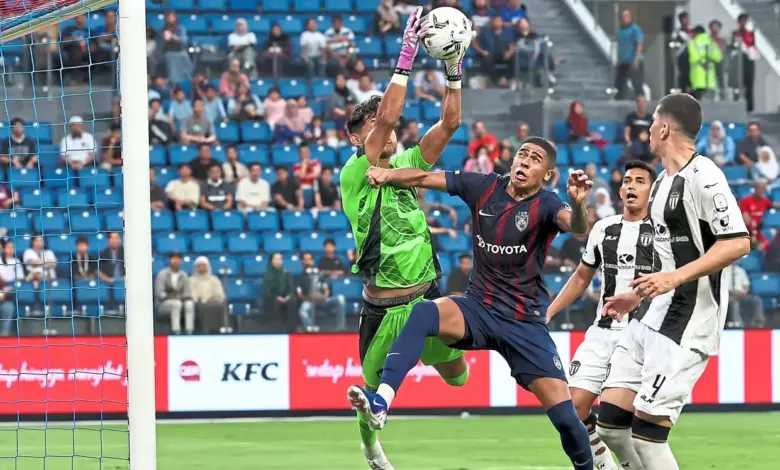
Johor Darul Ta’zim enter the al-ahli vs johor darul ta’zim quarter-final not simply as underdogs, but as a club trying to prove that years of domestic dominance can translate into continental credibility. This is being framed inside the club as its biggest night ever, and that label matters because it signals how much is at stake beyond one match in Jeddah.
What makes al-ahli vs johor darul ta’zim the most important match in JDT history?
Verified fact: JDT coach Xisco Munoz has called the quarter-final in Jeddah the most important match in the club’s history. He has also said the game will demand full focus, describing it as a final played over 90 minutes. That language is not decorative. It shows a team aware that the margin for error against Al-Ahli is likely to be very small.
Al-Ahli reached the quarter-finals after edging Al-Duhail 1-0 at the King Abdullah Stadium on Monday. JDT advanced after overcoming Sanfrecce Hiroshima, a run that secured their deepest progress in Asia. That alone changes the scale of the discussion around the club. For years, the team has dominated at home. Now it is being judged against a higher standard, one set by established heavyweights from East and Middle East football.
Analysis: The phrase al-ahli vs johor darul ta’zim captures more than a fixture. It exposes a test of identity. JDT are not just chasing a result; they are testing whether their structure, momentum and internal culture can survive against a side that arrives with greater continental pedigree and, on paper, more individual quality.
Who holds the advantage, and why does the gap matter?
Verified fact: Munoz has said Champions League matches demand everything, because opponents bring excellent individual players, solid structures and great pace. He also said the team must manage key moments before and after half-time, read the game well, and create chances.
Al-Ahli’s expected strength is clear from the names mentioned for the match: Ivan Toney, Riyad Mahrez, Roger Ibanez, Merih Demiral, Edouard Mendy and Frank Kessie. That list explains why Al-Ahli enter as favourites. It also explains why JDT’s path is so unusual. They are operating on a smaller budget than their Saudi opponents, yet the club believes organisation and identity can narrow the gap.
That is where the deeper question emerges. If a smaller-budget club can compete at this level, what does that say about the way Asian football power is distributed? The answer is not that the balance has shifted fully. The context suggests something narrower but more significant: JDT have built a platform strong enough to challenge a system that still rewards scale, spending and star power.
Analysis: The match is a referendum on whether progress built through consistency can survive contact with a roster built for instant impact. JDT’s case rests on continuity. Al-Ahli’s case rests on proven quality. Both are valid models, but only one advances.
What does JDT’s rise reveal about the club’s long-term project?
Verified fact: JDT’s rise has been driven by the vision of HRH Tunku Ismail, with chief executive Luis Garcia describing the club as one with clear leadership and a constant drive to improve every year. Garcia said everyone at the club is working in that direction and called this outcome the result of that approach.
Garcia also said the club has blended international recruitment with a pathway for local talent through the academy. That combination is important because it suggests JDT’s rise is not accidental. It is built on planning, recruitment, development and an expanding international presence.
The club’s progress to the last eight is already its deepest run in Asia, and Garcia said the side now wants to make the club, HRH Tunku Ismail and Malaysia proud. That statement adds a national dimension to the tie. It is no longer only about one club’s ambition. It is about what that club represents within Malaysian football and across the region.
Analysis: The significance of al-ahli vs johor darul ta’zim is that it compresses years of planning into one contest. JDT’s model has produced domestic control and continental relevance. What remains unproven is whether that model can now deliver a breakthrough against one of the region’s established elite clubs.
What should the public watch for next?
Verified fact: The quarter-final is being played at the King Abdullah Stadium in Jeddah on Friday. Al-Ahli are the favourites, but JDT say they will go there aiming to win the Champions League and will give 100 per cent.
The wider context also includes a proposed expansion of the ACL Elite to 32 teams from the 2026-27 season, with the number of league-stage clubs rising from 24 to 32 and split evenly between East and West. That proposal underscores that Asian football is still evolving structurally, even as clubs like JDT try to force their way upward within the current format.
For JDT, the immediate challenge is not structural change but execution. For Al-Ahli, the expectation is progression. For observers, the key issue is whether JDT’s rise has reached the point where ambition can be converted into a result against a more established opponent. That is the central tension in al-ahli vs johor darul ta’zim, and it is why this match carries significance far beyond one quarter-final. The evidence points to a club that has already changed its own ceiling; al-ahli vs johor darul ta’zim will show whether that ceiling can now be broken.