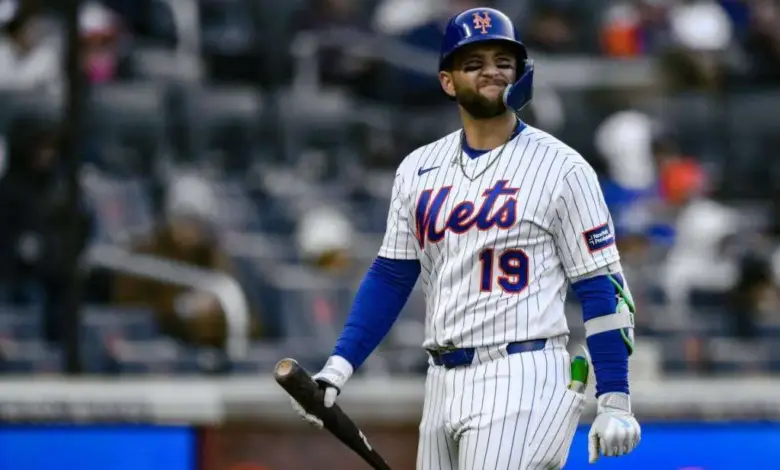
When Bo Bichette stepped into a New York spotlight built for quick judgments, bichette arrived with expectations that were never going to wait long. Through the first 17 games, his start has been uneven, and the early numbers have invited questions about both form and fitness.
The former Toronto Blue Jay is batting. 225 with a. 273 on-base percentage and a. 296 slugging mark, with one home run and nine RBI. For a player on a three-year, $126 million contract, the contrast between the deal and the production has become part of the conversation in New York.
Why does a New York start feel different?
’s Buster Olney, speaking on TSN 1050 Toronto on Tuesday, said Bichette is not the first star to arrive in New York and need time to settle. In Olney’s view, there is often a transition period when a high-profile player comes from outside and lands in one of baseball’s most demanding markets.
Olney pointed to the weight that comes with the move: the attention, the money, and the expectation that performance should arrive immediately. He said it is rare for a player to dominate from the start, and he framed Bichette’s beginning as part of a broader pattern rather than an isolated collapse. He also noted that only Bichette knows what he is feeling physically and mentally.
That wider lens matters because the story is not only about one hitter’s line. It is also about how quickly a new environment can magnify every missed swing and every quiet night. bichette is in a setting where slow starts become public debates almost instantly.
How much of this is about health?
There is also a physical question hanging over the numbers. Bichette suffered a PCL sprain in September last year, and he was still visibly hampered during the World Series, even while hitting. 348 with six RBI in seven games. The current struggles have revived concern that he may not be fully past that injury.
MLB Statcast data places him in the bottom three per cent in chase percentage and in the 14th percentile in sprint speed. A separate set of observations from MLB scouts, speaking anonymously, has suggested that he does not look fully healthy running the bases. Those scouts cited moments that raised concern about how freely he is moving.
For now, the data and the eye test are pointing in the same direction: Bichette’s bat has not fully clicked, and his speed has not looked like a strength. That does not prove a single cause, but it does explain why the discussion has shifted from a cold stretch to a deeper question about recovery.
What does this mean for the Mets right now?
The Mets are not dealing with Bichette’s start in isolation. The team has lost five games in a row, was shut out 4-0 by the Los Angeles Dodgers on Monday night, and entered Tuesday tied for last in the National League East with the rebuilding Washington Nationals.
Olney also stressed that Bichette is not the only player scuffling. He described the Mets lineup as having multiple problem spots, and the numbers back up that sense of collective drag. In that context, Bichette’s. 569 OPS is only one part of a broader offensive slump that has put pressure on the entire roster.
That is the challenge for the club: a marquee signing can be judged as much by timing as by talent. If the Mets want the contract to look like a turning point rather than a burden, they need a healthier, sharper version of Bichette to emerge soon. Until then, the early return remains incomplete.
What comes next for Bichette?
Bichette has already said he understood the challenge of playing in New York, calling it “a different animal” and noting that fans hold players accountable. That mindset may help him endure the scrutiny, but it does not answer the practical issue of whether his body is ready to match the contract and the expectations.
For now, the picture is clear enough without being definitive. bichette has not produced at the level New York hoped, his speed has been limited, and the lingering injury question keeps the story open. In a city that rewards quick impact, the pause is becoming its own headline.
By the next time he steps into the box, the scene will look the same: the lights, the noise, the expectation. What changes is the meaning attached to each at-bat, because in New York, a slow start is never just a slow start for long.