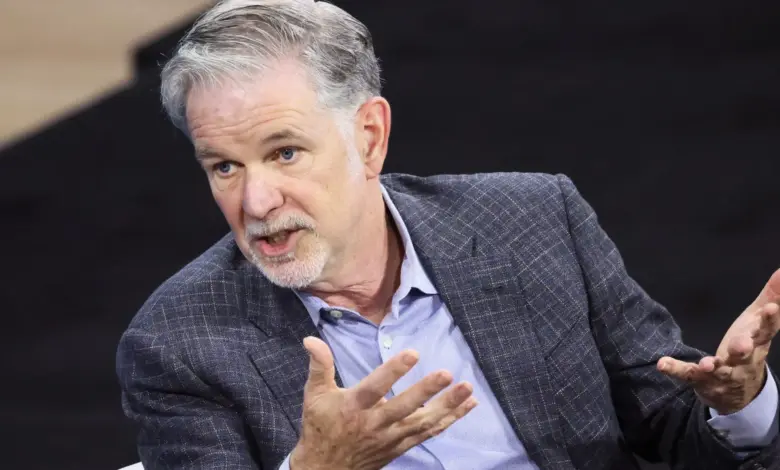
Reed Hastings is leaving Netflix at a moment when the streamer is trying to project calm after a failed reed hastings-era chapter that helped shape modern TV. its chairman will not stand for re-election at the annual meeting in June and plans to focus on philanthropy and other pursuits. The timing matters: Netflix has just absorbed the fallout from losing a $72 billion Warner Bros Discovery deal, even as it posted stronger-than-expected quarterly results and kept its full-year outlook unchanged.
Why the Reed Hastings exit landed so hard
Netflix said the stock fell about 8 percent after news of the departure, showing how closely investors still associate the company’s identity with its cofounder. That reaction came even though the quarter itself was financially solid. Earnings per share rose to $1. 23 from 66 cents a year earlier, while revenue climbed 16 percent to $12. 25 billion, slightly above analyst forecasts of $12. 18 billion. In other words, the market was not punishing weak numbers; it was responding to a leadership transition tied to a larger strategic setback.
The company had long framed a Warner Bros acquisition as a “nice to have, not need to have” proposition, but the loss of the deal has clearly sharpened the spotlight on succession and direction. Netflix also did not say how it plans to use the $2. 8 billion termination fee it received after losing the studio and HBO, leaving an open question about whether the cash becomes a buffer, a growth tool or both. The Reed Hastings departure, then, is not just symbolic. It arrives at the intersection of capital allocation, investor confidence and a company still defining its next phase.
What the company is signaling after the lost deal
Netflix reaffirmed in a 14-page shareholder letter that its mission remains “ambitious and unchanged, ” focused on entertaining the world with movies and series across tastes, cultures and languages. That message was paired with an unchanged full-year outlook, a sign that management wants to keep attention on execution rather than the failed transaction.
At the same time, the company is pointing to future growth channels that sit outside traditional streaming. It highlighted video podcasts and live entertainment, including the World Baseball Classic in Japan, as drivers of engagement. It also said technology improvements are being used to improve user experience and monetisation. Advertising remains a central pillar in that strategy, with revenue still on track to reach $3 billion in 2026, double the level of a year earlier.
This matters because the company appears to be balancing two narratives at once: a maturing core business that is still growing, and a broader push to make the platform more than a subscription service. The Reed Hastings transition gives that balancing act extra weight, because leadership change can amplify questions about whether the next phase will be as defining as the one he helped build.
Expert reaction and investor implications
Richard Greenfield, a media analyst at LightShed Partners, captured the split between financial strength and governance anxiety. “Netflix is growing revenues double-digits, expanding margins in 2026 and gushing free cash flow, ” he said. “While the Q1 was uneventful financially, the departure of Reed Hastings has spooked investors. ”
That reaction fits the market’s immediate response. Even with better earnings and revenue, the stock move showed that leadership credibility can outweigh a clean quarter when the executive involved is as closely identified with the company as its cofounder. The Reed Hastings announcement also lands at a time when Netflix is trying to convince shareholders that it can generate growth without leaning on a major acquisition. The company’s decision not to match Paramount’s higher bid for Warner Bros underscores that point.
Analytically, the key issue is not whether Netflix can survive Hastings’s departure. The company has already shown it can adapt strategically. The issue is whether investors view the next stage as a continuation of a proven model or the beginning of a more uncertain, less founder-driven era.
Broader streaming and Hollywood consequences
The loss of the Warner Bros deal leaves broader industry implications even if Netflix insists the acquisition was never essential. Hollywood has been reshaped by platform competition, and Netflix’s retreat from the transaction suggests a more selective posture in a market where scale alone no longer guarantees strategic clarity. The company’s focus now seems to be on monetising attention more efficiently, not simply expanding its library at any cost.
That is why the Reed Hastings exit carries weight beyond one board seat. It closes a chapter for a company that helped transform how movies and television are delivered in homes, while also exposing how much of its market value still rests on trust in leadership. If Netflix can keep revenue growing, lift advertising to its 2026 target and turn new formats into durable engagement, the transition may look orderly in hindsight. If not, the lost Warner Bros bid may be remembered as the moment the old story ended and the next one became harder to write.