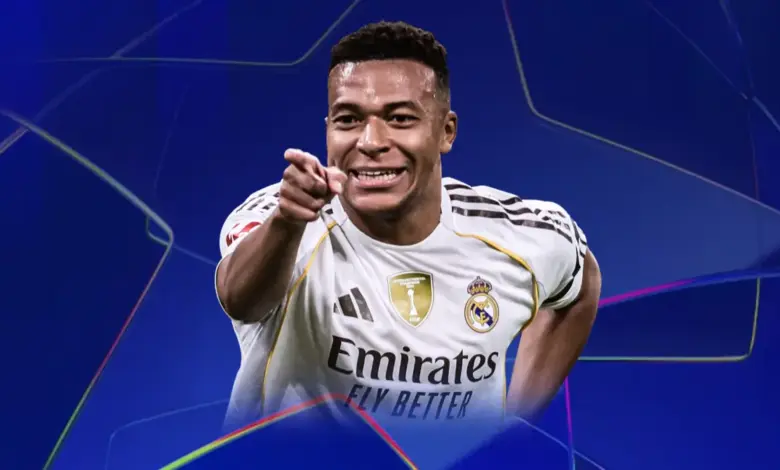
Kylian Mbappé turned a high-pressure Champions night into a record-breaking one, and the scale of the achievement is unusual even by elite standards. In Real Madrid’s quarter-final against Bayern Munich, his finish after Vinicius Junior’s pass not only gave Madrid a 3-2 lead in Munich, but also pushed him into a place no player had reached before: 10 away goals in a single Champions League campaign. The milestone arrived in just four matches, underlining how quickly one striker can reshape the narrative of a season.
Why this Champions moment stands out now
The immediate significance is simple: Mbappé has become the first player in history to score 10 away goals in one Champions League season. That figure matters because it is not a cumulative career marker, but a single-campaign benchmark that reflects consistency under hostile conditions. It also came in a knockout tie that remained finely balanced, with Madrid level at 4-4 on aggregate after the goal. In that setting, the strike carried both statistical and competitive weight, turning a record into a decisive contribution.
The broader context is equally striking. Mbappé’s goal was his 40th of the season and his 70th in the Champions League, numbers that place him in a rare scoring tier. He is also the competition’s top scorer this season with 15 goals in 11 games. Those totals are not presented here as prediction or projection, but as evidence of the current scale of his output. Within that framework, the away-goals record is less an isolated event than the sharpest expression of a remarkable run.
The numbers behind the record
What makes the record more notable is the pace. Mbappé needed only four games to reach 10 away goals, a rate that suggests exceptional efficiency in the competition’s most demanding venues. The context given for his scoring run includes a four-goal performance against Olympiacos in the group phase and a hat-trick against Kairat Almaty. Those matches help explain how the milestone was built, but they do not diminish the pressure attached to doing it in the knockout stage against Bayern Munich.
His season line for Real Madrid in LaLiga also shows the same pattern of production: 26 games, 23 goals and 4 assists. While the competitions are different, the overlap is important. It indicates that the Champions League record is not an anomaly detached from his domestic form. Instead, it sits within a broader season in which Mbappé has continued to deliver at volume after his high-profile move to Madrid in the summer of 2024.
Champions and the meaning of elite efficiency
In analytical terms, the record highlights the value of repeat impact in away matches. Away goals are earned in settings where control is harder, mistakes are punished more quickly, and attacking space must be created with precision. For Mbappé, the ability to translate those conditions into scoring output at historic levels is what separates this campaign from a standard prolific run. The fact that the decisive strike came from a counter-attack after Vinicius Junior’s pass also matters, because it shows how quickly Madrid can convert transitional moments into outcomes.
There is also a psychological layer. When a player repeatedly scores in difficult environments, the record becomes part of the opposition’s problem before the match even begins. That does not guarantee future success, but it changes how opponents must defend. In that sense, the Champions milestone is not only a statistic for the record books; it is a tactical signal that Madrid carry a forward capable of deciding ties from almost any starting point.
Expert reading of the milestone
Named institutional analysis in the provided context is limited, but the official performance data itself is enough to frame the significance. Real Madrid’s match situation, Mbappé’s 40 goals across the season, his 70 Champions League goals overall and his competition-leading 15 goals this term all combine to show a player operating at extraordinary scale. The facts do not require embellishment. The record is meaningful because it sits at the intersection of volume, consistency and timing.
From a football governance and statistical perspective, records like this are valuable because they create fixed reference points. They allow future campaigns to be measured not just against medals, but against a concrete standard of scoring efficiency. That is especially true in the Champions League, where the margin between a memorable season and an historic one can be a single away goal.
What this means for Madrid and the wider game
For Real Madrid, the immediate consequence is obvious: Mbappé has supplied a critical goal in a tie that remained open. Beyond that, the record strengthens the club’s attacking identity around a player already delivering at a relentless pace. For the wider game, it raises the bar for what elite forward production can look like across one Champions League campaign. The benchmark is now clear, and it is unusually high.
If Madrid progress, Mbappé’s 10 away goals in Champions would stand not just as a milestone, but as a possible turning point in a season built on decisive moments. If they do not, the record still remains as a rare achievement that will shape how this campaign is remembered. Either way, the question now is whether anyone will soon match a standard that was once thought unreachable.