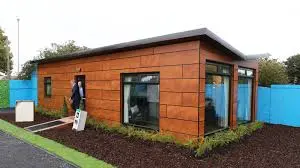
For some renters, beds in sheds is not a joke but a housing strategy. In Donabate, north county Dublin, Konstantina Kalliontzi has spent the past 10 months in a modular home at the back of a garden, paying €1, 150 a month under a licence agreement. Her experience is shaping a bigger debate now emerging inside Government: whether making small garden units easier to build will create a practical housing option or open the door to thinner standards and weaker oversight.
What the new garden-home push is trying to do
This week, Minister for Housing James Browne said he will advance long-flagged plans to exempt modular residential units between 32sqm and 45sqm from planning permission. The proposal is meant to reduce what he described as the regulatory burden on homeowners and families, while allowing planning authorities to focus on more complex projects.
The plan would apply only where the garden is at least 25sq m. The Department of Housing says the units would still need to meet building regulations, including access rules for people with disabilities. Full details will emerge once the proposed Exempted Development Regulations for Residential Dwellings are published.
Beds in sheds and the planning question
The central policy argument is straightforward: if Ireland needs more homes, then small modular units already built within existing residential plots may provide a faster route than conventional development. But the phrase beds in sheds captures the risk at the heart of the debate. If regulation is loosened without clear controls, a housing fix can drift toward an uneven market where quality depends on the landlord rather than the rules.
Kalliontzi’s account shows both sides of that tension. She describes her unit as a decent studio size, very new, and fitted with necessary appliances such as a mini-oven and a washing machine. Yet she also says it can become too warm in summer and too cold in winter, and that she kept the electric heater on almost continuously during colder periods. Her case suggests that even a relatively acceptable unit can still raise questions about comfort, energy performance and liveability.
Why the enforcement gap matters
Building regulation enforcement would rest with the 31 local authorities, which the Department of Housing says have extensive powers of inspection and enforcement under the Building Control Acts. That detail matters because the government is also planning to amend the Residential Tenancies Acts so these garden units can be rented under licence rather than through the Residential Tenancies Board.
That shift changes the balance of protection. A licence arrangement may be simpler for owners, and the state is also proposing that homeowners can earn up to €14, 000 in rental income tax-free in a similar setup to the rent-a-room scheme. But the more flexible the system becomes, the more important it is that building standards are actually monitored, not merely written down.
The policy logic is that a lighter planning regime will encourage supply. The policy risk is that fewer procedural hurdles can also lower the incentive to invest in durability, insulation and long-term habitability unless inspections are consistent and visible.
Expert perspectives on beds in sheds
Housing charities have already voiced concern about the risk to tenants under the modular home plan. That concern is rooted in a simple reality: people seeking cheaper, smaller accommodation often have limited bargaining power. In that environment, the quality of beds in sheds style housing can vary sharply even when the legal framework looks tidy on paper.
James Browne, Minister for Housing, has framed the proposal as a way to free up resources and reduce pressure on planning authorities. The Department of Housing says the units must still comply with building regulations, but the effectiveness of that safeguard will depend on how robustly local authorities enforce it.
Konstantina Kalliontzi’s experience shows how tenants may view the same policy through a practical lens. For her, the unit has been a temporary step toward saving to buy a house. For policymakers, it is a test of whether small-scale flexibility can expand housing choices without normalising substandard accommodation.
Regional consequences and the wider housing signal
If the plan proceeds, it could become a signal that the state is willing to formalise a type of housing that has often sat in a grey area. That may appeal to homeowners with underused garden space and to renters priced out of standard accommodation. But it also carries a broader message: housing pressure is severe enough that even very small units are being brought into the policy mainstream.
That matters beyond one garden in north county Dublin. If the exemption succeeds, it could encourage a wider shift toward compact, privately delivered housing. If it fails, the likely criticism will be that beds in sheds has merely been dressed up in regulatory language without fixing the deeper issue of secure, decent and affordable homes.
For now, the key question is whether the new rules will widen access to housing while preserving standards, or whether a faster route to supply will still leave too much to chance.