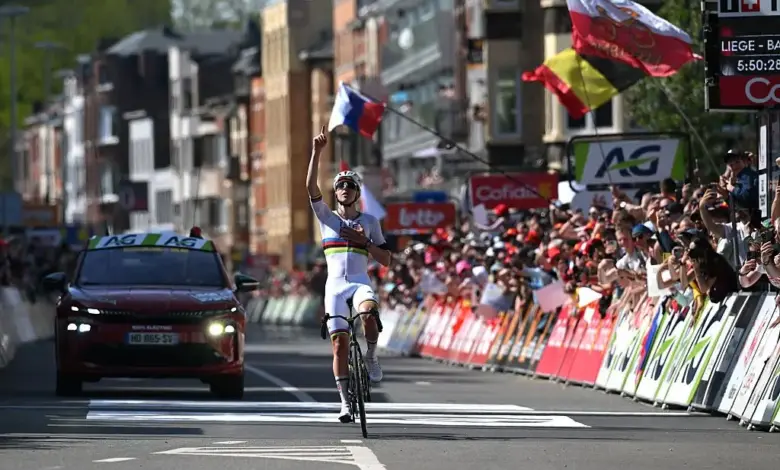
In the final climbs of Liège-Bastogne-Liège, paul seixas was still there when others had already drifted away. The 19-year-old French rider held on through a brutal day of racing, then watched Tadej Pogačar pull clear on the Côte de la Roche-aux-Faucons and ride away alone to a fourth victory.
How did the race turn on the final climbs?
The decisive move came after Pogačar had already split the race earlier on the Côte de la Redoute, following a lead-out from Benoît Cosnefroy. By the time the action reached Roche-aux-Faucons, the pressure had become too much for even the strongest remaining challenger. Pogačar attacked with 13. 9 kilometres left, and that was the moment the race changed shape for good.
For paul seixas, the key detail was not simply that he finished second, but that he was the only rider able to stay with Pogačar after the race fully fractured on Redoute. That made the final result feel less like a passive podium and more like a direct test of whether a young rider could absorb the repeated accelerations of a World Champion and still stay in the game. He could, for a long time. In the end, he could not hold the last surge.
What did Paul Seixas show on one of cycling’s hardest days?
The 112th edition of La Doyenne began in Liège with 173 riders facing 260 kilometres and more than 4000 metres of climbing. Early in the day, Remco Evenepoel got into a 54-rider breakaway inside the opening 5 kilometres, and that group stretched the race before being brought back after more than 150 kilometres of chasing.
Against that backdrop, paul seixas stood out because he did not disappear when the pace became severe. He held second place after a brave two-up battle with Pogačar, then remained on the podium when the race settled behind him. In a race defined by attrition, that mattered. It showed endurance, timing, and the ability to survive repeated pressure on the most selective roads of the day.
Pogačar’s own post-race words underlined that impression. He said he could see Seixas “a little bit on the elastic” on La Redoute, but was “really impressed” that the young rider came back over the top and continued to pull strongly. Pogačar added that he had been ready to sprint if needed, but felt Roche-aux-Faucons suited him and eventually delivered the winning move there.
Why did this second place matter beyond the result?
Second place at Liège-Bastogne-Liège does not soften the sting of missing a win, but it does give context. Paul Seixas, 19, had been looking to become the youngest winner in more than a century. That possibility ended on the final climb, yet the performance still confirmed his potential in a race where only the very best can remain visible deep into the finale.
There was also a wider competitive picture. Evenepoel, after his earlier effort in the break, was eventually dropped before Pogačar launched the decisive move, then took third in the sprint for the final podium place. The final classification therefore reflected both resilience and limits: Pogačar’s dominance, Seixas’s resistance, and Evenepoel’s ability to salvage a place on the podium after a difficult race.
Pogačar’s fourth Liège-Bastogne-Liège win also carried historical weight, drawing him level with Alejandro Valverde and Moreno Argentin on all-time victories at the race, with only Eddy Merckx ahead on five. For paul seixas, that same result framed his own ride in a sharper light: he was not merely part of the race, but part of the small group that could stay close enough to measure themselves against a modern benchmark.
What comes next after a ride like this?
Pogačar finished his Spring Classics campaign with a fourth win and a third Monument from just five appearances in 2026. For Seixas, the story is less about a season tally and more about what this one day revealed. He proved he could absorb the violence of a race like Liège-Bastogne-Liège, respond on the key climbs, and still finish second after the field had been torn apart.
That is not a consolation prize so much as a marker. In a race where Pogačar won with power and control, paul seixas emerged with a different kind of statement: he belonged in the move that mattered, and he stayed there longer than most. On a mountain road where the champion finally escaped, the young Frenchman was the last challenger left standing.