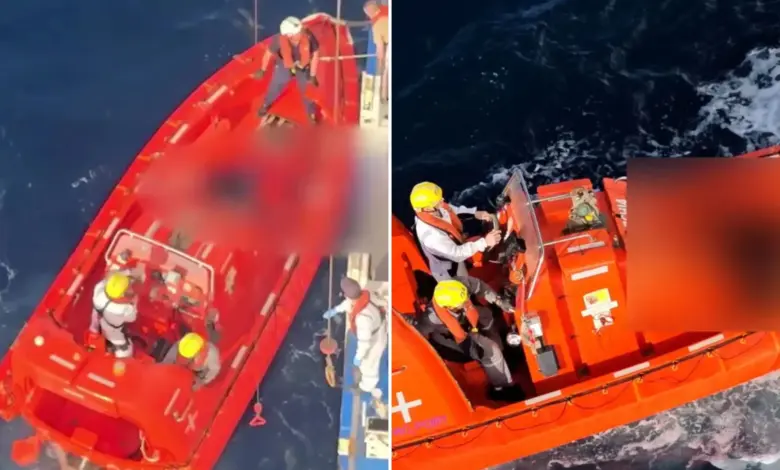
When crew aboard the princess cruises ship Sapphire Princess spotted an orange object in the western Mediterranean Sea at 6 p. m. ET on Tuesday, the voyage changed in an instant. What passengers first thought was a floating marker turned into a recovery mission that would end with five deceased individuals brought on board, a reminder that the ocean can shift from routine travel to human tragedy without warning.
What happened on the Sapphire Princess?
The ship altered course after the orange object was identified as a lifejacket. Crew deployed the vessel’s Fast Rescue Boat and began recovering people from the water. Footage showed the body of a male in a purple top and black shorts being pulled into a lifeboat, covered with canvas, and moved onto the ship. Medical staff examined him before he was taken to the hold, and the cruise ship moved off again at 6: 59 p. m. ET.
By 7: 47 p. m. ET, another orange lifejacket was spotted, and a second body was brought on board. Three more bodies were later recovered, completing a three-hour mission that ended with five deceased individuals aboard the Sapphire Princess. Princess Cruises confirmed that the vessel was en route to Cartagena, Spain, and that the individuals recovered were not guests or crew.
How did passengers experience the incident?
For the people traveling on a ship with more than 3, 000 passengers, the event unfolded in full view. One passenger, who asked not to be named, said the scene was deeply upsetting. “It was very sad to watch. I was shaking inside, ” the passenger said. The same passenger said the crew kept people calm, that everyone was shocked, and that the crew treated the deceased with respect. Passengers were also offered counselling.
Another passenger said the moment stood out because it was unlike anything seen on previous cruises. The ship was sailing between the coasts of Spain and North Africa before docking in Cartagena on Wednesday. The voyage had departed from a port near Rome, Italy, on April 19 and was scheduled to dock in Copenhagen, Denmark, on May 3. Within that itinerary, the detour to recover bodies made the scale of the tragedy impossible to ignore.
Why does this recovery matter beyond one voyage?
The recovery highlights how cruise ships can become first responders when they encounter distress at sea. In this case, the orange lifejacket became the signal that led the crew to stop, turn back, and act. Princess Cruises said the vessel observed the lifejacket, altered course immediately, and coordinated with the Maritime Rescue Coordination Center to complete the recovery.
That cooperation matters because the incident was not only a maritime event, but a human one. it extends sincere condolences and is grateful to the crew for their swift response and efforts to render assistance. The account also points to the emotional burden placed on crew and passengers alike when an ordinary journey intersects with a fatal incident at sea.
What response came from the crew and the company?
Princess Cruises said the crew deployed a Fast Rescue Boat and worked with the Maritime Rescue Coordination Center during the recovery. Medical staff examined the first body after it was brought aboard. Passengers were told what had happened, and counselling was offered. Those details suggest an effort not only to complete the mission, but to manage its emotional impact on the ship.
The company’s statement also made clear that the recovered individuals were not connected to the cruise itself. That distinction is important: the ship was carrying holiday travelers, yet it became part of a grim emergency unfolding in open water. The recovery was finished before the ship continued toward its next port.
What stays with passengers after the ship moves on?
For passengers, the memory may linger longer than the voyage. The orange object in the water, the lifeboat, the canvas, and the silence that followed all turned a normal cruise into a moment of witness. The ship has moved on, but the scene remains tied to the reality that princess cruises can, at times, be drawn into events far beyond the expectations of leisure travel.
In the end, the question left behind is not only how five bodies came to be in the Mediterranean, but how many more such moments pass unnoticed at sea. On this ship, at least, they were seen, recovered, and carried ashore with care.