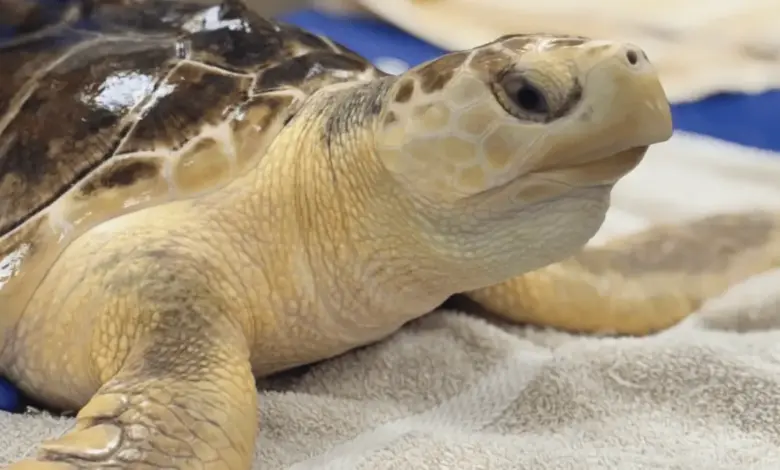
In a recovery room at the Georgia Sea Turtle Center in Jekyll Island, Georgia, one of the newest patients is drawing careful attention. sea turtles arrived there after being rescued from New England’s coastal waters, but Earl Grey stands out: genetic testing showed the animal is a first-generation hybrid with a loggerhead father and a Kemp’s ridley mother.
The discovery is more than a surprise for the staff caring for Earl Grey. It opens a narrow window into how two very different species can meet, mate, and leave behind offspring whose future behavior and survival are still not fully understood.
How did rescuers discover Earl Grey was different?
At first, staff assumed Earl Grey was a loggerhead. But the turtle’s appearance did not fully match that identification. The beak was more hooked and the shell shape more round, traits associated with Kemp’s ridley sea turtles. That unusual combination led the team to run a genetic test.
The result confirmed what visual inspection could not: Earl Grey is a first-generation hybrid. The Georgia Sea Turtle Center said the finding was unusual and emphasized that hybrid turtles of any kind are incredibly rare. The center also noted that Kemp’s ridleys are the world’s most endangered sea turtle species.
For the staff, the test turned a puzzling patient into a valuable case. The rescue center said more research is being done on the turtle population, and each confirmed case adds to what scientists can learn from a living animal that does not fit neatly into one category.
What makes this hybrid sea turtle so unusual?
Kemp’s ridleys and loggerheads differ in size, behavior, and nesting patterns. Kemp’s ridleys are the smallest sea turtle species and nest in only two places, in Texas and Mexico. Loggerheads are much larger and nest across multiple oceans. That contrast is part of what makes Earl Grey’s parentage so striking.
Jaynie L. Gaskin, director of the Georgia Sea Turtle Center, said the union of the two species is interesting because of those differences. She said there is still much to learn from hybrid individuals and raised questions that remain unanswered: where they nest, what they eat, and how they move through different life stages.
Gaskin also said each confirmed case helps scientists better understand how these animals are adapting in the wild and allows conservation strategies to evolve alongside them. Hybridization happens naturally, especially in areas where species intersect, but most cases are only verified through genetic testing. Experts do not have dependable estimates of wild hybrid sea turtles right now.
How did Earl Grey end up in care?
Earl Grey came into human care after cold stunning, a condition that occurs when water temperatures drop too quickly and turtles become weak, sluggish, and poor swimmers. That leaves them more vulnerable to injury, disease, and stranding.
The turtle was found on a beach in Brewster, Massachusetts, then treated at the New England Aquarium before arriving at the Georgia Sea Turtle Center in November. The staff cared for Earl Grey alongside other cold-stunned turtles, giving food, water, and immediate medical attention.
The center named several of the rescued turtles after tea varieties, including Chai, Earl Grey, Boba, Darjeeling, Matcha, Jasmine, Peppermint, Chamomile, and Oolong. For Earl Grey, that routine care became the start of a longer scientific story.
What happens next for Earl Grey and other rescued sea turtles?
Earl Grey has been regaining strength and energy over the past few months and is described by the Georgia Sea Turtle Center as full of personality and getting better each day. Once fully recovered from cold stunning, the turtle is expected to be released back into its natural habitat.
Gaskin said rehabilitation facilities should consider genetic testing for any suspected hybrid sea turtles, because there may be more individuals than currently realized. In Earl Grey’s case, a simple physical difference led to a deeper discovery about sea turtles, conservation, and the limits of what can be known from appearance alone.
Inside the center, the patient in the tank is still just one turtle among many. But for the team watching Earl Grey heal, the animal represents something larger: a rare reminder that sea turtles can carry unexpected histories, and that careful rescue work can uncover them.