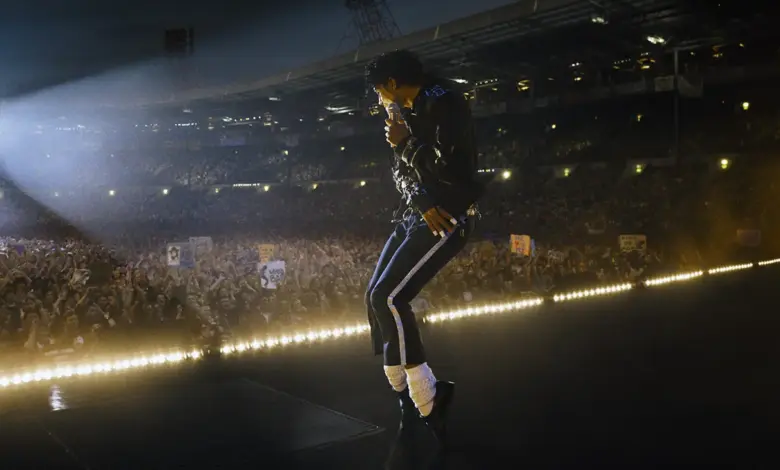
The Jackson 5 name carries a long shadow in the new biopic Michael, and that shadow has become part of the film’s larger pull. The movie is not only drawing strong audience interest; it is also forcing viewers to confront how family history, performance, and controversy sit side by side in one crowded cultural moment.
Why is Michael turning into such a big box office story?
The answer starts with the scale of its opening. Antoine Fuqua’s Michael Jackson biopic is tracking far ahead of expectations, with domestic estimates rising to the $94 million to $100 million range and global receipts projected north of $200 million. Lionsgate has widened its own domestic range to $90 million to $100 million, a sign of how quickly the film’s momentum has accelerated.
That surge is being driven by audience response. The film earned $38. 5 million on Friday alone, and its exit scores have helped push the conversation far beyond early criticism. The audience score on Rotten Tomatoes reached 96 percent, PostTrak exit scores landed in the low 90s, and 85 percent of viewers gave a definite recommend. The film also earned an A- on CinemaScore, suggesting that moviegoers are responding with more enthusiasm than critics initially did.
The opening matters not just for one title, but for the studio behind it. It is set to become Lionsgate’s biggest opening in years and one of the strongest biopic openings of all time. Nearly 40 percent of the gross is coming from Imax and other premium large-format screens, showing that the film is being treated like a major event rather than a standard release.
How does Jackson 5 fit into the film’s human story?
At the center of that story is Jaafar Jackson, who plays his uncle Michael. He is the son of Jermaine Jackson, and Jermaine was part of the Jackson 5 group that gave Michael his start as a child. That family connection gives the film a layer of intimacy that goes beyond casting; it also helps explain why viewers keep asking whether Jaafar is really singing in the movie.
The answer is yes, but with a blend. Jaafar Jackson said he sang live over Michael’s track during performance scenes, creating a mix of his own voice and Michael’s. He also said some a cappella moments use only his voice. That detail matters because it turns the film from a simple impersonation into something more personal, built on imitation, rehearsal, and inherited performance.
Jaafar said he practiced for hours on end and described preparing so intensely that his feet would bleed or go numb. Those words give a human scale to a production that, from the outside, can look purely commercial. Here, the work of sounding like Michael becomes part of the film’s emotional core.
What do audiences and critics see differently?
The split is sharp. Critics’ scores hovered in the high 20s and low 30s before moving up to 40 percent, while audiences responded with enthusiasm. That gap has become one of the defining features of the film’s release. It suggests that viewers are engaging with the movie less as a strict verdict on history and more as a cultural event built around performance, family memory, and one of the most recognizable names in popular music.
The numbers also suggest broad reach. The film has attracted virtually every major demographic, with Black and female moviegoers leading the turnout. That kind of turnout helps explain why the movie could move from a projected opening in the $65 million to $70 million range to a much larger result by the end of the weekend.
There is also a wider historical tension hanging over the release. The biopic remains controversial because of child sex abuse accusations surrounding Michael Jackson, including a 1993 settlement and a 2005 not guilty verdict on 14 sexual abuse-related charges. That history is part of the public conversation even as the film’s commercial performance races ahead.
What does this moment mean for the people around the film?
The response has ripple effects beyond the box office. Jermaine Jackson has supported his son through the process, and family attendance at the premiere underscored that this production is not only about an icon, but about relatives carrying a legacy in public. Director Antoine Fuqua has also pointed to Janet Jackson’s support for Jaafar, even though she does not appear in the film.
The larger lesson is that Michael is working on two levels at once: as a commercial hit and as a family story filtered through performance. The Jackson 5 legacy remains part of the frame, not as background decoration, but as the origin point for a dynasty that still shapes how people watch, judge, and remember Michael Jackson.
For now, the film’s opening weekend leaves one image in focus: a crowded theater, an audience leaning in, and a story that began with the Jackson 5 still echoing through the present.