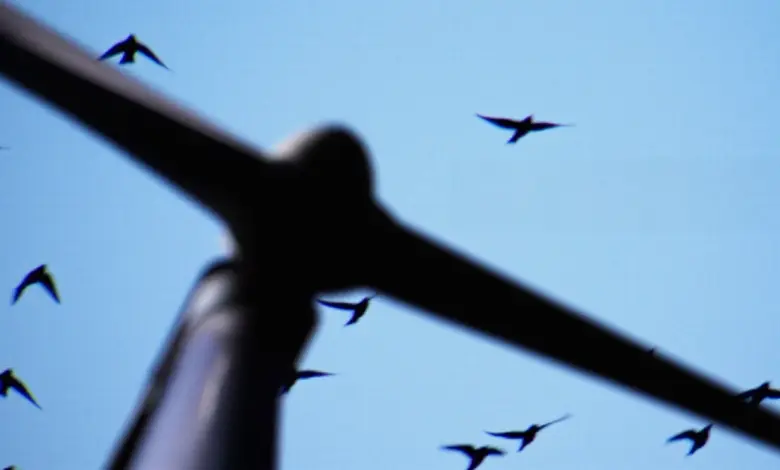
At a time when wind energy is expanding, the debate around each wind turbine is no longer only about power output. It is also about what happens in the air around it, where birds and bats move through space that developers, regulators, and communities all need to understand.
What is The Birdwatcher trying to change?
“Our objective was to make complex data impossible to ignore, ” said Federico Fanti, Regional Chief Creative Officer at FP7 McCANN MENAT. That line sits at the center of The Birdwatcher, a campaign launched by Spoor in collaboration with FP7 McCANN MENAT to turn AI monitoring data into a public record.
The campaign presents wind energy as something meant to protect the future, while also acknowledging the risks that remain around birds and bats near wind farms. Those risks include collisions, habitat disruption, and buffer zones that can slow development. The idea behind The Birdwatcher is to show that wind energy and wildlife can coexist when the evidence is visible and usable.
For decades, the wind industry relied on human observers with binoculars to track bird activity. That approach produced slow and fragmented data, and the result was often oversized buffer zones and stalled permits. Spoor says its approach is meant to replace uncertainty with evidence that can be acted on earlier in the process.
How does the wind turbine monitoring system work?
Spoor’s technology combines AI-powered computer vision, geometric flight analysis, and ecological domain knowledge to detect, track, and classify birds. The system can also enable curtailment at wind energy sites to help prevent fatalities. In practical terms, it is meant to give operators a clearer picture of bird and bat activity around a wind turbine before and during operations.
The Sky Intelligence Platform uses camera-agnostic AI to monitor wind sites continuously, with detection ranges of up to 1. 5 kilometres and at least 95% accuracy. It provides bird and bat activity data that can support permitting, risk mitigation, operational decision-making, and compliance. The same data can also be used in site prospecting, environmental impact assessments, and mitigation planning.
Ask Helseth, CEO of Spoor, said: “Every wind project faces the same question from regulators, communities and investors: what happens to the birds? We built the technology to answer that with evidence, not assumptions. ” He added that the data shows coexistence is achievable and should no longer remain buried in reports that most people never read.
Why does this matter for communities and development?
The question is not only technical. It is social and economic too. Slow, fragmented bird monitoring can delay permits and shape how wind projects are planned. When data is incomplete, buffer zones can grow larger than necessary, and that can affect where and how projects move ahead.
The campaign says the argument against wind energy has often been built on missing data. By making bird activity visible, it aims to change who can understand the issue and who can act on it. That includes policymakers, regulators, communities, and investors, all of whom are part of the approval and development process.
One case study at Aberdeen Bay showed how the system works in real conditions. Over 19 months, one system monitored bird activity around a turbine, captured approximately 95 percent of daylight hours, recorded 2, 007 bird tracks, flagged five potential collision events, and confirmed none. Independent scientific trials validated the system’s detection and tracking capabilities against human observations, with recall rates confirmed in a peer-reviewed report.
What is being done now?
The Birdwatcher campaign turns Spoor’s data into an open, accessible experience. It includes an interactive microsite, a dedicated Instagram feed documenting bird activity, and a physical bird guidebook with augmented reality features distributed to stakeholders. The point is not only to collect data, but to make it visible in forms that people outside technical teams can understand.
Spoor says the system can also monitor bird activity from a buoy, FLiDAR, or metocean platform, expanding its use across onshore and offshore wind projects. The company frames this as a way to support biodiversity monitoring, habitat protection, and smarter siting decisions before turbines are built.
Back at the site in Aberdeen Bay, the bird activity around a wind turbine was not just a data point. It became part of a wider question: how much of the conflict around wind energy comes from what cannot be seen, and how much changes when the evidence is brought into view? The Birdwatcher is betting that visibility itself can move the debate.