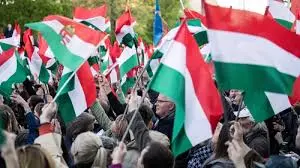
Hungary elections are carrying an unusually high-stakes question: whether Viktor Orbán’s 16 years in power are nearing their end. Early turnout pointed to a highly mobilized electorate, with a record 16. 89% voting after three hours, six points higher than four years ago. That surge matters because this vote is not only about who governs in Budapest. It may also shape Hungary’s position in the European Union, NATO, and its relations with Russia and the United States.
Record turnout and a sharper political mood
The pace of voting suggests an electorate that is more engaged than in the previous contest. Polls have favored Péter Magyar, who built his Tisza party after splitting from Fidesz, the ruling party that Orbán has led through four consecutive victories. Magyar has cast this moment as a chance for a broader reset, promising to strengthen Hungary’s standing in the EU and NATO and to act against corruption. Orbán, meanwhile, sought to project confidence after voting in Budapest, saying, “I am here to win. ”
The turnout figure is one of the clearest early indicators in the Hungary elections race. It does not decide the outcome, but it signals that both camps have managed to energize their supporters. Orbán’s late-campaign message remained focused on Brussels, Ukraine, and sovereignty, while Magyar urged voters not to give in to “Fidesz pressure and blackmail. ” The contrast is stark: one side warning of external threats, the other promising institutional change.
What is driving the challenge to Orbán
Orbán has governed Hungary for 16 years, during which the European Parliament described the country as a “hybrid regime of electoral autocracy. ” That phrase matters because it frames the current vote as more than a routine transfer of power. Magyar and Tisza are offering what they call a “change of regime, ” tied to a reset in relations with the EU and an end to Hungary’s close ties with Russia. Whether that agenda can translate into parliamentary power is now the central question.
The political backdrop is also shaped by economic strain and scandal. The context includes revelations that Foreign Minister Péter Szijjártó regularly spoke to his Russian counterpart before and after EU summits, which he has admitted. Orbán has also angered European partners by vetoing €90bn in aid to Ukraine. In a country that is both in the EU and NATO, those choices have become part of the electoral argument over Hungary’s direction.
Election specialist Róbert László of the Budapest-based think tank Political Capital says Hungary’s three most reliable pollsters are all pointing to a “huge lead” for Tisza. He adds that many analysts expected that margin to narrow near election day, but it has not. That leaves the race open to a result that could still surprise on either side of the parliamentary threshold.
Hungary elections and the balance of power
The structure of parliament makes the result especially important. Magyar has argued that his camp needs not only an absolute majority of 100 seats in the 199-seat parliament, but a two-thirds super-majority to roll back many of the constitutional changes introduced under Fidesz. Those changes touched the independence of the judiciary, ownership of the media, and other parts of public life. Even if Tisza wins decisively, the scale of that victory will determine how much can actually be reversed.
This is why the Hungary elections are being watched far beyond the country’s borders. A shift in Budapest could alter how Hungary behaves inside the EU and NATO, and it could also affect the wider political mood in Europe, the US, and Russia. Orbán remains a valued figure for Donald Trump, who urged Hungarians to “get out and vote” for his “true friend, fighter, and WINNER. ” That endorsement highlights how the contest has become a symbolic test of alliances as much as domestic leadership.
Experts see a possible break, but not a clean sweep
László’s assessment points to a split outcome: a comfortable majority for Tisza is possible, but a two-thirds majority is not guaranteed. That distinction is crucial because it separates winning office from changing the system. If Magyar falls short of the stronger threshold, he may still claim a mandate for reform, but the tools available to him would be narrower.
The deeper issue is whether voters want continuity or a reset. Orbán’s supporters rallied around family policy, resistance to Brussels, and his stance on the war in Ukraine. His critics have focused on the economy, corruption concerns, and Hungary’s tense position inside European institutions. The result will show which of those messages had greater force on election day.
Regional consequences beyond Budapest
Because Hungary is embedded in both the EU and NATO, the outcome carries implications that extend well beyond domestic politics. A Magyar victory could open the door to a different tone toward Brussels and a less confrontational stance on Ukraine. A renewed Orbán mandate would reinforce a model that has already tested the patience of Hungary’s European partners.
For now, the vote remains a live contest, with results expected during the evening after polls close at 19: 00 ET. The record early turnout suggests that Hungarians understand what is at stake. The unresolved question is whether this moment marks the end of Orbán’s long dominance, or just another chapter in a political system that has repeatedly proven difficult to overturn through Hungary elections.