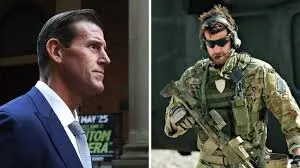
The word soldier sits at the center of a national argument in Australia this week, after Ben Roberts-Smith was placed on remand in Sydney’s Silverwater prison. For many Australians, the arrest of a Victoria Cross recipient has forced an uncomfortable clash between the image of a war hero and the gravity of five war crime charges.
Why has this arrest landed so hard?
Roberts-Smith was once described by former prime minister John Howard as the “modern personification of the Anzac tradition. ” That language matters because the Anzac story is not just military history in Australia; it is part of the country’s identity, tied to the exploits of young men on foreign fields and remembered as a kind of civil religion by the late historian Ken Inglis.
The charges now facing Roberts-Smith are serious. He is accused of five counts of committing “war crime – murder, ” tied to the deaths of five Afghan men between April 2009 and October 2012. He has not entered a plea and is expected to face a bail hearing this month, with a trial to come later. He has always denied the allegations.
The case has not emerged in isolation. In 2023, a civil court found on the “balance of probabilities” that Roberts-Smith had committed war crimes in Afghanistan in a defamation case he himself brought. That case upheld the work of two investigative journalists from the Nine newspapers, and it already had unsettled public confidence before the criminal charges deepened the crisis.
How did a war hero become a national fault line?
The public response has reflected deep divisions that run along long-established cultural and political lines. Some voices have reacted with caution and sympathy, while others have treated the arrest as a challenge to values they believe should protect men who served in combat.
Gina Rinehart, Australia’s richest person, said she “didn’t understand” the rationale for charging Roberts-Smith and others who remain under investigation. She added that she hoped “compassion and the Aussie spirit” would be extended to him and his family, while remembering “his duty to our country in the hardship of war. ” Pauline Hanson, whose One Nation party is rising in the polls, said she would not “abandon” him and declared, “I remain steadfast in my support of Ben Roberts-Smith despite news of his arrest today. ”
Two former conservative prime ministers offered more restrained reactions. Tony Abbott said his “instinctive sympathy” remained with special forces soldiers from the Afghanistan campaign who “fought bravely and well for a just cause, ” while also calling the rules of engagement “highly restrictive. ” John Howard said the arrest would “tug at the heartstrings” of many Australians, but stressed that one of the country’s core values remained the rule of law.
What does this say about Australia’s Anzac identity?
The emotional force of the case comes from the way it collides with a national myth that is still powerfully alive. In that myth, the soldier is not just a person in uniform but a symbol of sacrifice, courage and national virtue. That is why the sight of a decorated former commando on remand can feel, to many, like more than one man’s legal problem.
Prof Marilyn Lake, a historian at the University of Melbourne, has long challenged parts of that myth making. She said her 2010 book “What’s Wrong with Anzac?” created significant controversy, and that she was “frequently accusing” of being a traitor. Her experience suggests how difficult it can be to question patriotic narratives when they are bound so tightly to identity.
That tension now hangs over Roberts-Smith’s case. It is not only about whether the charges will be proven in court. It is also about how a country that has built so much of its self-image around war service responds when a decorated figure is accused of breaking the laws of war.
For now, the man once celebrated as a hero of the battle of Tizak waits in prison, and Australia waits with him. The outcome will matter in court, but the deeper reckoning may be cultural: what happens when the public image of a soldier no longer matches the story a nation has told itself for generations?
Image alt: Soldier Ben Roberts-Smith and the Australian debate over Anzac tradition