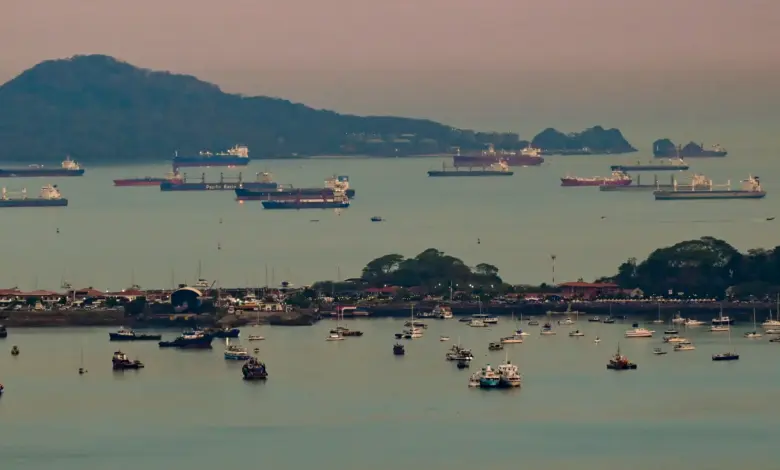
The panama canal has become the center of a dispute that now reaches far beyond port contracts. A joint statement from the United States, Bolivia, Costa Rica, Guyana, Paraguay and Trinidad and Tobago says China has used targeted economic pressure after Panama’s Supreme Court invalidated the legal framework behind key terminal concessions. The immediate issue is ships, ports and contracts. The larger issue is whether maritime trade is being pulled into a political contest.
What is being said about the detentions?
Verified fact: US officials say China detained nearly 70 Panamanian-flagged ships in March after the court ruling in Panama. The Federal Maritime Commission described that number as far exceeding historical norms. The joint statement from the six governments says the detentions were a blatant attempt to politicise maritime trade and infringe on sovereignty. It also says Panama’s independent Supreme Court made its decision on the Balboa and Cristobal terminals, and that the response afterward amounted to targeted economic pressure.
Informed analysis: The sequence matters because the detentions are being framed not as isolated maritime enforcement, but as pressure tied to a legal and commercial reversal in Panama. That gives the dispute a wider significance: it is no longer only about who operates terminal infrastructure, but about who can influence the commercial consequences of a court decision.
Why does the Panama Canal matter in this dispute?
Verified fact: Panama’s Supreme Court annulled contracts in late January that had allowed a subsidiary of Hong Kong-based CK Hutchison to administer the Balboa and Cristobal port terminals on the panama canal. The court deemed the decades-old agreements unconstitutional. After that, temporary arrangements gave APM Terminals, part of A. P. Moller – Maersk, control of Balboa, while Terminal Investment Limited, controlled by Mediterranean Shipping Company, took over Cristóbal pending a new framework.
Verified fact: CK Hutchison’s Panama Ports Company is separately seeking international arbitration against Panama and pursuing more than $2bn in damages. The company’s removal also triggered criticism from Beijing, which described the ruling as absurd and shameful and rejected the accusations tied to the ship detentions.
Informed analysis: The dispute now links a domestic court ruling, the management of strategically located terminals, and the treatment of vessels carrying Panama’s flag. That combination makes the panama canal a test case for how economic leverage can be applied after legal action changes control of critical infrastructure.
Who is backing Panama, and what are they saying?
Verified fact: Marco Rubio, the US secretary of state, said Washington was deeply concerned by China’s economic pressure on Panama and said attempts to undermine Panama’s sovereignty are a threat to all. Laura DiBella, chair of the Federal Maritime Commission, said the intensified inspections appeared intended to punish Panama after the transfer of Hutchison’s port assets. She also said Panama-flagged ships carry a meaningful share of US containerised trade and that the consequences could be commercial and strategic.
Verified fact: China has accused the United States of bullying and of trying to smear its reputation in Latin America. It has also rejected the claim that the detentions were part of a punishment campaign.
Informed analysis: The public positions are sharply defined. The six-country statement puts sovereignty at the center. US officials place shipping pressure at the center. China rejects both the premise and the accusation. What is striking is that each side is using the language of principle, while the practical battlefield remains the same set of ships, ports and terminal arrangements.
What does this reveal about the wider contest?
Verified fact: The dispute intensified after Panama’s court ruling, at a time when the canal was already under heightened scrutiny because of threats by US President Donald Trump to seize the strategic waterway. In January 2025, Trump said in his inaugural address that China was operating the canal and pledged that the US would take back control.
Informed analysis: Taken together, the facts show a layered confrontation. First came the legal decision in Panama. Then came the transfer of terminal control. After that came detentions, diplomatic criticism and claims of retaliation. The result is a dispute in which maritime regulation, contract law and geopolitical messaging now overlap. That overlap is what makes the case harder to dismiss as a routine commercial disagreement. It also explains why the phrase panama canal now carries meaning far beyond geography.
For Panama, the central question is whether its court ruling can stand without triggering punishment through shipping channels. For the United States and its partners, the question is whether those detentions represent a precedent for economic coercion. For China, the question is whether its response is being cast as retaliation in a way that narrows the debate before the facts are fully settled.
Accountability conclusion: The evidence now points to a dispute that demands more transparency from all sides: on the legal basis for terminal changes, on the standards used in ship detentions, and on the political motives attached to both. Without that clarity, the panama canal will remain not only a route for trade, but also a route for pressure.