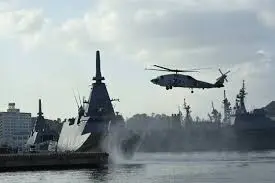
At a dockside moment in Melbourne earlier this month, Australia Japan Frigate Deal became more than a procurement headline. It signaled a practical response to a fleet that is set to shrink unless new ships arrive fast enough to replace older ones.
Under Project Sea 3000, Australia and Japan signed an agreement for three upgraded Mogami-class frigates for the Royal Australian Navy. The deal was sealed aboard JS Kumano, with defense ministers from both countries present. For a navy facing a smaller surface fleet, the agreement carries both urgency and symbolism.
Why does this frigate deal matter now?
Australia’s surface combatant fleet stands to fall to its smallest size since World War II, and that reality frames the urgency behind the purchase. The Royal Australian Navy currently has ten surface combatants: three Hobart-class destroyers and seven Anzac-class frigates. Those Anzac-class ships will be replaced by the upgraded Mogami.
The first three frigates will be built by Mitsubishi Heavy Industries in Japan, with delivery of the first ship expected by December 2029. Another eight frigates will later be built in Western Australia. Over the next decade, the shipbuilding program is slated to cost up to A$20 billion, a figure that has doubled from what was indicated two years ago.
For the navy, the issue is not just numbers. Rear Admiral Stephen Hughes, the Royal Australian Navy’s Head of Naval Capability, described the upgraded Mogami as a major leap in technology and operating methods. He said the new ships would allow the navy to “jump a generation in technology, ” not only in combat systems but in how the fleet is crewed and run.
What does Australia Japan Frigate Deal change for both countries?
The deal is being treated as Japan’s largest-ever defense export, giving a major boost to its shipbuilding industry while advancing strategic alignment between the two countries. That dual significance helps explain why the agreement has drawn such attention inside defense circles.
For Australia, the attraction lies in speed and compatibility. Minister for Defence Industry Pat Conroy said this is the fastest acquisition for the Royal Australian Navy in peacetime. He also said Australia is working closely with Japanese and Australian industry partners to acquire one of the most advanced general-purpose frigates in the world.
The ships will carry a mix of weapons and systems, including ESSM Block 2 surface-to-air missiles in a 32-cell Mk 41 vertical-launch system, deck-mounted Naval Strike Missiles, MK 54 lightweight torpedoes and a SeaRAM. Japanese systems and sensors will also feature prominently, including the combat management system, sonar and UNICORN mast.
How are industry and the navy responding?
Subcontracts are already being awarded, including to NEC for equipment such as sonars and UNICORN integrated masts, and to Rolls-Royce for MT30 gas turbines. That matters because the plan depends not only on hulls in the water, but on a wider industrial chain that can deliver parts, systems and support on schedule.
Hughes said the aim is to make as few Australianized changes as possible, because any added modification would delay delivery. In his view, the selection process focused on choosing the best ship with the most compatible capability for the Australian navy’s use. He also said the upgraded Mogami is larger and more capable than the Anzac class and will offer greater availability of 300 days at sea annually.
The broader picture is a navy in transition. Australia Japan Frigate Deal is not a simple replacement order; it is a shift toward a different force with different opportunities. Hughes rejected the idea that the navy should be judged only by ship counts, saying the issue is capability.
By the end of the program, Australia and Japan will operate a combined fleet of 35 Mogami frigates. In the short term, the first ship will not arrive until 2029. In the longer term, the dockside scene in Melbourne may be remembered as the moment Australia chose to rebuild its surface fleet around a faster, more advanced path forward.