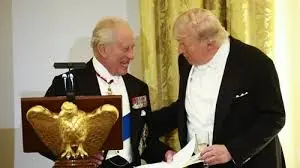
At the White House state banquet, the room felt larger than ceremony. In the middle of a visit meant to celebrate friendship, the phrase state banquet became part of a wider effort by King Charles III to ease strain in US-UK relations and turn diplomacy into something more human.
Why did the address matter so much?
The answer is simple: this was not only a formal visit. It was also framed as a rescue mission. The state of US-UK relations has been strained, and the King’s joint address to Congress was meant to soften that tension through what amounted to a royal charm offensive. He spoke of “reconciliation and renewal, ” a theme he returned to later at the White House state banquet.
The symbolism carried extra weight because it was the first royal address to Congress since Queen Elizabeth II spoke at the Capitol in 1991. In the chamber, the King spoke openly about “times of great uncertainty” facing both nations, pointing to conflicts in the Middle East and Europe and to the threat posed to democracy by political violence. The message was careful, but it was not empty. It linked global instability to the kind of unease felt inside political institutions, where words can land as warnings as much as greetings.
What did the reaction inside Congress reveal?
The response suggested that the speech touched more than protocol. When the King said that executive power should be “subject to checks and balances, ” and tied that idea to a British legal tradition enshrined in the Magna Carta, the chamber rose in a standing ovation. The cheers began among Democrats before spreading across the room.
That detail mattered because it hinted at how differently the speech was heard. For some lawmakers, the lines about checks and balances echoed current concerns about power and restraint. When the King later said, “America’s words carry weight and meaning, as they have since independence. The actions of this great nation matter even more, ” the reaction on the Democratic side suggested a mix of agreement and unease. The moment became less about pageantry and more about the meaning of public language in a divided political climate.
How did the speech reflect wider tensions?
The wider pattern was visible in what the King chose to address and what he left out. He spoke of shared history, of alignment between the two nations, and of what they can do “not just for the benefit of our peoples, but of all peoples. ” He also quoted Henry Kissinger when discussing an Atlantic partnership and noted that Nato mobilised in defence of a member-state only after the 9/11 terror attacks by al-Qaeda. That framing placed the speech inside a long arc of alliance, rather than the immediate disputes that have made relations tense.
At the same time, the speech avoided the flashpoints most visible in the current moment. It did not mention Iran, Israel, immigration, or climate. That restraint was part of the strategy: a measured appeal to common ground rather than a list of grievances. In that sense, the state banquet and the congressional address worked as mirror images of the same idea. One used ceremony, the other used language, but both tried to steady a relationship under pressure.
Who noticed the political undertones?
Some lawmakers heard a message that went beyond ceremony. Adam Schiff, a California lawmaker, said on social media that the United States had ignored and assailed the British to the point of being at war with Iran, and without a friend to be found. The King did not go there. Instead, he offered a broad argument for cooperation and continuity.
On the other side, the atmosphere in the chamber showed how unusual the moment was. Vice-president JD Vance was applauded on entering, followed by senators and cabinet members taking seats near the front. Nancy Pelosi and John Thune were both part of the same rare scene of bipartisan enthusiasm. The response underlined how royal visits can create a political pause, even when the issues behind them remain unresolved.
What does the state banquet add to the story?
The state banquet added a second layer of meaning to the visit. The King returned there to the theme of reconciliation and renewal, giving the evening a sense of continuity with the speech in Congress. Together, the two settings showed how diplomacy can be performed through mood, ritual, and restraint.
For all the applause, the larger question remains open. A state banquet can project warmth, and a speech can win a standing ovation. But the strain in US-UK relations was real before the visit, and it is not erased by ceremony alone. The room at the White House may have glowed with unity, yet the deeper test lies ahead: whether the friendly language heard beside the state banquet table can survive the harder business of politics.