Nanaimoteuthis Octopus and the Ancient Sea Monster That Changed What Scientists Thought They Knew

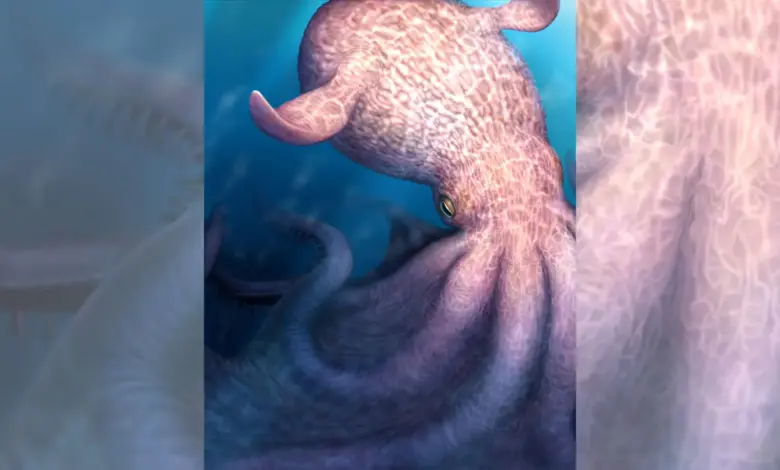
In rocks from Japan and Canada’s Vancouver Island, scientists have pieced together the story of nanaimoteuthis octopus, a creature that may have moved through the oceans 100 million years ago with a body far larger than any octopus alive today.
The picture comes from fossil jaws, rare hard parts left behind when most of an octopus’s body disappeared before burial. Those jaws point to an animal that could have reached up to 19 metres in total length, a scale that pushes this ancient cephalopod into a new class of prehistoric giant.
What did scientists find in the fossil jaws?
Researchers at Hokkaido University in Japan reexamined 15 fossil cephalopod jaws and identified 12 more preserved in rocks, using layer-by-layer imaging and a digital model built with artificial intelligence. In all, 27 specimens that had once been thought to belong to five extinct species were reassigned to just two: Nanaimoteuthis jeletzkyi and the larger N. haggarti.
The key clue was the jaw itself. One lower jaw from N. haggarti could cradle a grapefruit and was about 50 percent bigger than that of the 12-metre modern giant squid. From that evidence, the team estimated a body length of about 1. 5 to 4. 5 metres, and a total length of roughly 7 to 19 metres once the arms are included.
That estimate matters because it places nanaimoteuthis octopus among the largest invertebrates ever known to scientists. For decades, palaeontologists assumed the biggest ocean predators were vertebrates such as fish and reptiles, while octopuses and squid played supporting roles. This study challenges that idea directly.
How did nanaimoteuthis octopus fit into the ancient ocean?
The fossil jaws suggest an animal built to hunt and to handle hard prey. Scientists say early octopuses may have been powerful predators with strong arms for grabbing prey and beak-like jaws for chewing shells and bones. The analysis also suggests these animals could have chewed on the hard shells and skeletons of large fish and marine reptiles.
There is another detail that gives the animal a more individual profile. The wear on the fossilised jaws is uneven from left to right, which suggests the animals may have favoured one side when feeding. In living animals, that kind of side preference is linked to advanced brain function. Modern octopuses are known for intelligence, problem solving and complex hunting strategies.
Christian Klug, a palaeontologist at the University of Zurich, reviewed the research and said, “With their tentacles and their suckers they could perfectly hold on to such an animal and there is no escape. ” His view adds to the sense that the ancient seas may have held a predator with unusual control over its prey.
Why does this matter for the Cretaceous food chain?
The animal lived during the Late Cretaceous Period, about 72 million to 100 million years ago, when dinosaurs ruled on land. The fossil evidence suggests nanaimoteuthis octopus may have been among the top predators in the oceans at the time, potentially rivaling or exceeding the size of huge reptiles such as mosasaurs and long-necked plesiosaurs.
Dr Nick Longrich, a paleontologist at the University of Bath, said his hunch is that the animal mainly preyed on ammonites. Even so, he noted that like the modern octopus, it would likely have been an opportunistic and voracious predator that did not pass up other prey if it had the chance. That picture places the species not as a side character, but as an active force in the ancient marine ecosystem.
What remains unknown about this giant octopus?
There is still much scientists cannot yet pin down. They can only guess at the exact shape of the animals, the size of the fins, or how quickly they could swim. No fossil has been found with stomach contents that would offer direct evidence of what they were eating. Those limits keep the story grounded: the jaws are strong evidence, but not the final word.
Even so, the fossil record now offers a sharper view of a creature that once lurked beneath the ancient seas. In the twilight of the age of dinosaurs, nanaimoteuthis octopus may have been a giant hidden in plain sight, leaving only its jaws behind to challenge long-held assumptions about who ruled the ocean.