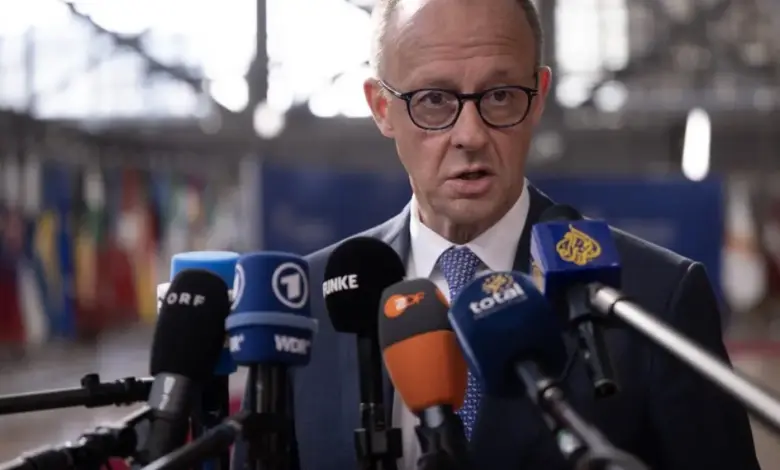
German Chancellor Merz used a classroom setting in Marsberg to describe a war that is no longer just about missiles and talks. In remarks on Monday, he said german chancellor merz was watching a moment in which the United States was being “humiliated” by Iran’s leadership, and he tied that judgment to stalled negotiations, rising economic strain, and a wider sense of uncertainty.
What did German Chancellor Merz say about the talks?
Merz said Iranian officials were “obviously very skilled at negotiating, or rather, very skilful at not negotiating, ” pointing to the way US negotiators were sent to Islamabad and then left without an agreement. He added that “an entire nation is being humiliated by the Iranian leadership, ” and he singled out the Islamic Revolutionary Guard Corps in that criticism.
The comments came after Donald Trump cancelled a trip by US negotiators to Islamabad for indirect talks with an Iranian delegation. A previous round in the Pakistani capital had also ended without progress. That backdrop gave Merz’s remarks extra force, because they openly challenged the White House’s effort to frame the deadlock as an advantage.
Why does this matter beyond diplomacy?
The dispute now reaches far beyond the negotiating table. Iran has put forward a new ceasefire proposal centered on opening the Strait of Hormuz while postponing other issues, including nuclear weapons, missiles, sanctions, and more. The proposal was conveyed to Washington by Pakistani mediators and, if accepted, could ease a global economic and energy crisis tied to the US-Israeli attack on Iran in February.
But the economic picture inside Iran is already severe. The International Monetary Fund has forecast a 6. 1% contraction in Iran’s gross domestic product this year, while year-on-year inflation is running at nearly 70%, with food staples and healthcare rising even faster. The blockade has also left Iran’s empty tankers unable to return to port for storage, limiting the country’s ability to manage its output.
For merz, the consequences are not abstract. He said the conflict has a direct impact on Germany’s economic output and warned that the fallout is already costing money. That concern reflects a broader European anxiety: the war is unsettling shipping routes, energy supplies, and prices at a moment when governments are trying to avoid more instability.
How are Europe and international institutions responding?
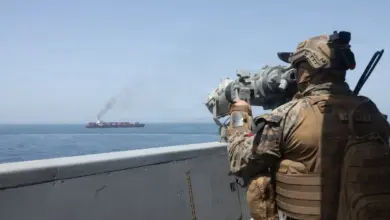
Germany is not standing entirely on the sidelines. Merz said Berlin remains ready to deploy minesweepers to help secure shipping routes through the Strait of Hormuz, though only if hostilities stop. That offer shows how quickly a regional conflict can pull in a European government concerned about trade, fuel flows, and maritime security.
International institutions have also drawn lines. The UN’s International Maritime Organization rejected the idea of fees on ships passing through the strait. Arsenio Dominguez, the organization’s secretary general, said there was no legal basis for any tax, customs charge, or fee on international navigation through a strait.
At the same time, Iranian foreign minister Abbas Araghchi met Vladimir Putin and a Russian delegation in Moscow on Monday, part of Tehran’s effort to soften the pressure created by the blockade. The picture that emerges is not one of a frozen conflict, but of a widening one, with diplomacy, shipping, and economic survival all colliding at once.
Why did Merz choose such blunt language?
Merz’s language was striking because it did not stop at criticism of Iran. It also implied that the US side had been outmaneuvered. He said the Iranians were “clearly stronger than one thought, ” adding that the difficult part in any conflict is not only getting in, but getting out again. He drew on the long and painful lessons of Afghanistan and Iraq to warn that wars can become traps if leaders cannot define an exit.
That is why german chancellor merz matters in this story: his remarks link the immediate failure of talks to the larger cost of escalation. The scene in Marsberg was calm and ordinary, but the message was not. Behind the classroom walls sat the same unresolved question now hanging over diplomats, shippers, and consumers alike: how long can the pressure build before someone finds a way to step back?