Merz and the Iran war: the missing U.S. strategy at the center of a growing transatlantic split


Merz has turned the Iran war into a question of leadership, timing, and consequences. His central claim is stark: the United States lacks a convincing strategy, while Iran is extracting political and diplomatic advantage from the conflict. That assessment now collides with a separate reality: the European Commission has already rejected any easing of Iran sanctions, closing off one of the few options Merz had mentioned.
What is not being told about Merz and the Iran war?
The most revealing detail is not a battlefield update but a political judgment. Verified fact: Federal Chancellor Friedrich Merz said the Americans have no strategy in the Iran conflict and that the Iranian side is humiliating them. He added that the United States went into this war without a clear plan. He also said that the conflict has direct consequences for Germany’s economic performance.
Informed analysis: The issue is not only whether the war can be contained, but whether Western governments are aligned on what comes next. Merz’s warning suggests a deeper concern: if Washington is improvising, then Europe is being forced to react to a crisis it did not shape and was not asked to join at the outset.
Why did the sanctions debate narrow so quickly?
Verified fact: European Commission President Ursula von der Leyen rejected Merz’s floated idea of easing Iran sanctions. That response matters because it removes a possible diplomatic lever just as the conflict is intensifying. It also shows that the European position is not moving in step with the political tone set by Merz.
Verified fact: The White House said President Donald Trump spoke on Monday with senior security advisers about an Iranian proposal involving the blockade of the Strait of Hormuz. White House press secretary Karoline Leavitt said the proposal is being discussed, but would not say whether Trump will accept it. US Secretary of State Marco Rubio called the idea unacceptable, saying an opening of the waterway under strict Iranian conditions would not be acceptable for the United States or other states.
Informed analysis: These positions show a narrow corridor for diplomacy. One side is discussing a conditional opening of a major shipping route; another is dismissing the offer as unusable; a third is refusing to soften sanctions. The result is not clarity, but competing signals.
Who benefits from the current stalemate?
Verified fact: The context places Iran, the United States, Israel, Russia, Germany, and the European Union in the same widening frame. Israel’s Prime Minister Benjamin Netanyahu said the threat from rockets and drones remains central in the fight against Hezbollah. Israel’s Defense Minister Israel Katz warned Hezbollah leader Naim Kassem that continued rejection of talks could have serious consequences. Separately, Vladimir Putin met Iran’s foreign minister and praised bilateral relations.
Informed analysis: The benefit of stalemate is not evenly distributed. For Tehran, the dispute over Hormuz appears to be a bargaining instrument. For Washington, any acceptance of a conditional opening could look like concession. For Europe, the absence of a shared line raises the risk of being economically exposed while politically sidelined. For Merz, the danger is domestic as well as international: his warning about Germany’s economic performance ties foreign policy directly to national interests.
What do the facts say about the U. S. role?
Verified fact: Merz said he had already raised his skepticism twice directly with Trump. He also said Germans and Europeans were not asked when the American and Israeli attacks on Iran began. That is a specific political complaint, and it goes to the heart of the present dispute: Europe is being asked to absorb the consequences of a war it did not help initiate.
Verified fact: Merz also invoked Afghanistan as a warning, describing the long withdrawal problem in conflicts where entering is easier than leaving. This is not a side remark. It is his framework for understanding the war in Iran: escalation may be easier than resolution, but both come with costs.
Informed analysis: If the U. S. lacks a strategy, as Merz argues, then each new move becomes harder to interpret as part of a coherent endgame. That uncertainty weakens allies, complicates talks over sanctions, and makes maritime security in the Strait of Hormuz even more politically sensitive.
What happens if the Hormuz dispute hardens further?
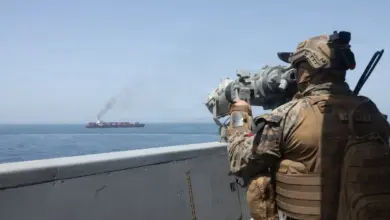
Verified fact: The Strait of Hormuz is described in the context as a strategically important passage for oil and gas shipments from the Gulf region. The Iranian proposal under discussion would link any opening of the blockade to reciprocal action by the United States and later talks on the nuclear program. Rubio rejected that framing, calling it not an opening but a system where Iran would keep control over passage.
Informed analysis: The core contradiction is now visible. Merz says the war is inflicting damage and that it should end quickly. Brussels refuses sanctions relief. Washington is still testing an Iranian offer. Tehran is using access to a global shipping lane as leverage. Those positions do not add up to a shared diplomatic strategy; they add up to a managed drift toward deeper confrontation.
The accountability question is therefore simple: who is defining the end of this conflict, and on what terms? If the United States is acting without a strategy, if Europe is rejecting relief, and if Iran is bargaining through pressure on Hormuz, then public debate needs more than slogans. It needs transparency about objectives, red lines, and costs. That is the gap Merz has exposed, and it is the gap that now shapes the Iran war.