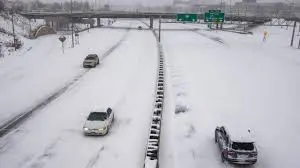
Spring may be on the calendar, but a heavy snow warning is once again steering attention back to the Mountain West. The National Weather Service has issued winter weather advisories for Colorado, Montana, and Wyoming as a late-season system brings heavy snowfall, strong winds, and the kind of reduced visibility that can quickly turn routine travel into a hazard. The most exposed mountain areas could see up to 12 inches of snow, while some higher elevations may do even more. The concern is not only accumulation, but timing: weekend travel and the early-week commute are both at risk.
Weekend storm pattern puts the Mountain West in the crosshairs
The National Weather Service said an upper-level system moving onshore over California on Saturday will push east toward the Upper Midwest by Monday evening. In the process, it is expected to generate rain with embedded thunderstorms over parts of Northern California and Nevada on Saturday and Sunday, while late-season light snowfall spreads across the higher elevations of the Northern Rockies, the Northern Intermountain Region, the Sierra Nevada Mountains, the Great Basin, and the Central Rockies.
Within that broader setup, the heavy snow warning stands out for three states facing the most immediate impacts. In Wyoming, the Cheyenne office issued a heavy snow warning for the Sierra Madre Range and Snowy Range, including Albany and Centennial, where 12 inches of heavy, wet snow is expected. Battle Pass could see up to 24 inches. In Colorado, the Grand Junction office warned of up to 12 inches of snow and winds reaching 45 mph in areas including Skyway, Crested Butte, Taylor Park, Marble, Monarch Pass, McClure Pass, Buford, Trappers Lake, Silverton, Molas Pass, Coal Bank Pass, Rico, and Hesperus. Grand Mesa could also approach 24 inches.
Why the travel risk is more serious than the totals alone
The headline numbers matter, but the combination of snow type, wind, and timing matters more. In Colorado, the expected 45 mph winds raise the risk of blowing snow and sharply reduced visibility. That is what makes the storm operationally disruptive: not just how much falls, but how hard it is to see and move through it. In Wyoming, the National Weather Service warned hikers, hunters, and snowmobilers that falling and blowing snow could become dangerous and disorienting, especially in higher terrain.
Roads are a major concern as well. The National Weather Service said drivers should prepare for slippery conditions, especially along Interstates 25 and 90 north and east of Buffalo. In parts of north-central and northwest Wyoming, 3 to 10 inches of snow is expected from Sunday afternoon into Monday morning, with the Monday morning commute potentially affected. In Montana, snowfall looks lighter in comparison, but still enough to matter: up to 6 inches in the north-central region along the Rocky Mountain Front, especially Marias Pass, and 4 to 9 inches in parts of south-central and south-central eastern Montana, including the Pryor Mountains and the northern Bighorn Mountains near the Wyoming border.
What the National Weather Service is signaling
A heavy snow warning is not simply a forecast for snow; it is a signal that conditions may become difficult enough to disrupt travel and outdoor activity in a short window. In this case, the warning language is consistent across the region: dangerous conditions, reduced visibility, and travel that could become very difficult. Montana’s winter weather advisory is expected to end at noon on Sunday, but the broader regional pattern continues into early next week before conditions ease.
The seven-day outlook points to a gradual return to more typical weather for the time of year. Snow showers remain possible, mainly in the afternoons and evenings, but little or no accumulation is expected. Daytime highs are forecast to range from the low 40s to the low 50s, with overnight lows in the mid-20s. Winds are expected to stay gusty from Sunday through Thursday, though the overall trend is toward a warmer and drier pattern by next weekend. That shift matters because it suggests the storm is not the start of a sustained winter lock-in, but it is still severe enough to demand caution now.
Regional impact and the bigger takeaway
For Colorado, Wyoming, and Montana, the immediate effect of the heavy snow warning is concentrated in mountain travel, high-elevation recreation, and road safety. The broader lesson is that late-season storms can still generate high-impact conditions even as spring advances. Heavy, wet snow combined with 45 mph winds creates a different hazard profile than a calm snowfall: outages, reduced visibility, and difficult driving become more likely even when totals vary by location.
That is why the warning stretches beyond one mountain range or one state line. The system is affecting a wide swath of western terrain, and the difference between a pass that gets a few inches and one that gets two feet can be decisive for travelers. If the weather service’s forecast holds, the most important question is not whether snow will fall, but how many communities will have to adjust plans before the roads, passes, and higher elevations finally quiet down. How much disruption will this heavy snow warning create before conditions return closer to normal?