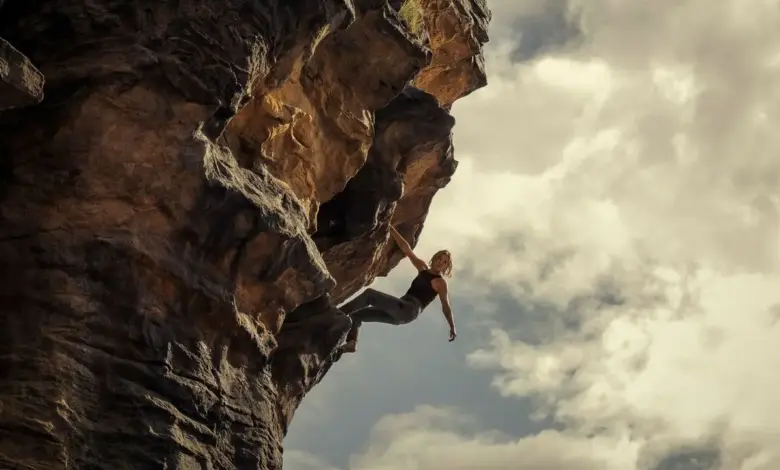
In action sequences that feel stripped of safety nets, the setting becomes part of the story. That is exactly what happened with Apex, the survival thriller that sent Charlize Theron into the Australian wilderness and pushed the production into real landscapes rather than relying only on constructed spaces.
Why did Apex go so deep into Australia?
Director Baltasar Kormákur built much of Apex around real locations because he wanted the environment to shape the performances. He said he prefers to use nature first before moving to a set, because the limits of working outdoors give actors a clearer sense of the challenge ahead. For Kormákur, the tension between control and uncertainty is part of the craft, and that approach has informed earlier work as well.
For Apex, that meant filming across rugged places in Australia, with key scenes shot in the Blue Mountains, Canberra, and Engadine. The final climb for Theron’s character, Sasha, was filmed at Glenbrook Gorge and on a stage. Some climbing and kayaking were recreated on sets, but Kormákur insisted on pairing those moments with actual locations. That choice helped the film’s physical world feel immediate, even when the production had to switch between real terrain and controlled conditions.
What does the story ask of Charlize Theron?
Theron plays Sasha, a rock climber living through the loss of her partner, played by Eric Bana. She travels to Australia by kayak and then finds herself trapped in a deadly cat-and-mouse struggle with a local character played by Taron Egerton. The role asks her to return to skills her character had buried, including rock climbing, while carrying grief and fear at the same time.
Theron said the film was written for a colder place, and she made clear that cold water would not suit her. Kormákur adjusted the production’s direction with that in mind, shifting the shoot to the southern hemisphere. Her comments point to a practical reality behind the film: location was not just a backdrop but a condition that helped define what could be done and how the story could unfold.
How did real places shape the performance?
Theron said immersion in the environment helped her understand Sasha. In her view, the character can only be fully reached through the circumstances around her. She also said she loved the people and the places where the film was shot, calling the experience helpful as an actor because it kept informing the performance from moment to moment.
The physical setting mattered beyond scenery. Kormákur described the appeal of remote, rugged terrain as both emotional and logistical. He said the Australian shoot made sense financially, but he was also drawn to the fact that the wilderness could make the work harder in ways that mattered on screen. That is the logic behind the film’s approach: the body is not separated from the landscape; it is tested by it.
What did the crew gain from filming on location?
Kormákur said one of the most rewarding parts of the shoot was hearing from Australian crew members who thanked him for taking them to places they had never seen or heard about. He said the production went deep into remote areas, mirroring the journey Sasha must endure. That sense of shared travel gave the film a practical and human dimension: the story was about survival, but the making of it also became a test of endurance and trust.
For a film built around fear, grief, and physical struggle, that matters. The choice to use real places did not just add texture; it supported the emotional shape of the narrative. The more the actors had to respond to wind, water, rock, and distance, the more the setting could carry part of the story’s weight. In a film like Apex, that balance can sharpen the drama without needing to overstate it.
What stays with the viewer after the climb?
By the time the final climb arrives, the scene is not only about danger. It is about how much of Sasha has survived the journey into the wilderness and how much the wilderness has demanded in return. The film’s use of real Australian locations gives that question added force. In Apex, action is not an abstract genre label; it is tied to place, weather, and physical risk. That is what gives the film its lingering tension.
Image alt text: Action in Apex unfolds in the Australian wilderness with Charlize Theron and Baltasar Kormákur on location