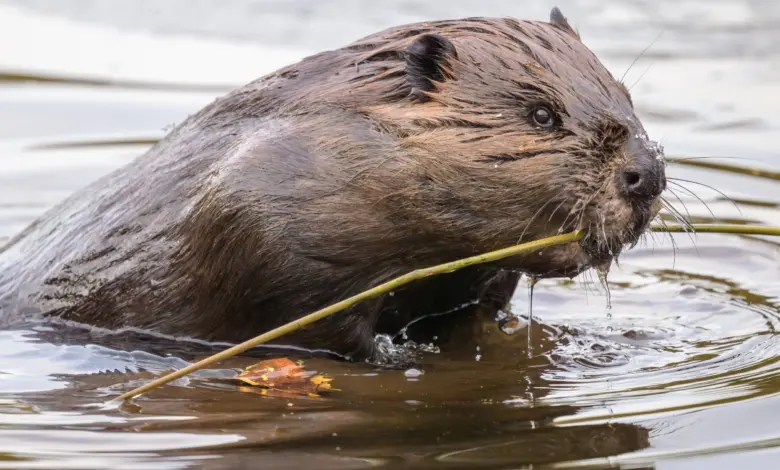
The Arctic rarely holds still, but the arrival of beavers is adding a new kind of change. In one northern region, the Arctic is not only warming and shifting in the familiar sense; it is being actively remade by an animal that leaves a physical record behind. Scientists now show that the beaver’s movement into the tundra has altered water, land, and even the way researchers reconstruct past ecological change.
How the landscape recorded the change
The first clue was not a dramatic sighting but a missing history. Researchers working in the Canadian Arctic tundra had no direct record of when beavers first arrived, so they turned to the landscape itself. Led by Georgia M. Hole, then at Anglia Ruskin University and now at Durham University, the team used dendrochronology and plant scars to build a timeline of expansion. Hole said that in the Arctic, historical baselines are often lacking, and the study shows a way to reconstruct that missing history.
The method relied on small plants along creek banks, especially willows and green alders. Beavers cut these plants for food and building, leaving marks that can be dated. Hole described the animals as writing their history into the landscape through each shrub cut and every pond created by damming streams. The team linked those browsing scars with hydrological changes visible in satellite imagery, allowing them to identify when and where beavers were present.
What the fieldwork found across the tundra
Between 2022 and 2024, the researchers traveled along a 130-kilometer stretch of highway and worked with the Imaryuk Monitors, an Indigenous environmental group. They documented 60 beaver lodges and dams. They also collected 94 chewed plant samples from three main sites and 99 untouched plants. Those samples helped produce a timeline reaching back to 1968.
The timeline showed the first signs of beavers at the northernmost site in 2008, followed by the southern site in 2011 and the central site in 2015. Taken together, the dates indicate that beavers entered the region about 18 years ago and have since spread gradually into more areas. As they expanded, they built more dams and lodges, which helped them settle and extend their reach across the tundra. That pattern matters because it shows that a species long associated with wetlands farther south is now reshaping Arctic rivers and lakes in ways that are measurable, cumulative, and likely to continue if the spread does not slow.
Why this matters for Arctic change
The broader significance is not only that beavers have arrived, but that they are altering the environment in a region already undergoing change. The Arctic does not stay still: ice shifts, plants creep forward, and animals follow new paths. The beaver adds another layer by changing water flow and local landform patterns through dam building. In this case, the study used every Landsat satellite image of the region from 1984 onward, calculated a wetness index, and applied a statistical model designed to detect abrupt change. That combination strengthened the finding that the landscape has been changing in step with beaver expansion.
For people living there, the change is not abstract. The animals are changing water, land, and daily life. Even without a direct historical record of the first arrival, the evidence now shows a clear northward movement and a physical footprint that can be traced through plants, ponds, and satellite data. The study also illustrates a wider scientific point: in remote regions, ecological change can advance before anyone has a continuous record to measure it. In that sense, Arctic transformation is being documented not just by climate indicators, but by the animals adapting to them.
Expert view and the wider regional impact
Hole’s explanation points to a larger challenge for northern research: the lack of historical baselines. Her team’s approach shows that ecological history can sometimes be recovered from scars, rings, and water changes rather than from direct observation. That is important because the beaver’s spread is not isolated. It interacts with a landscape already in motion, where ice, vegetation, and animal ranges are shifting together. The result is a compounded transformation, with one species accelerating changes that would otherwise be harder to detect.
Across the region, the implications extend beyond one species and one stretch of tundra. If beavers continue to move north, the physical shape of streams, ponds, and wetlands may keep changing, creating new habitat patterns and new pressures on local ecosystems. The study does not predict an endpoint, but it does establish a clear directional trend: the Arctic is being reshaped by beavers, and the evidence is written into the land itself. What happens when the next wave of change arrives in a place that is already being rewritten?