solar flares have pushed into focus again after two X-class eruptions struck within seven hours, briefly disrupting radio signals across the sunlit side of Earth. The timing matters because the active region is near the sun’s western limb, where the geometry can limit direct impact but still leave room for changing space weather conditions.
What Happens When Solar Flares Hit the Dayside of Earth?
The two eruptions were powerful enough to trigger strong radio blackouts over different parts of the dayside of Earth. The first affected parts of the Pacific Ocean and Australia, while the second impacted East Asia. One flare peaked at 9: 07 p. m. ET on April 23, and the next followed at 4: 14 a. m. ET on April 24. That is a short interval for back-to-back X-class events, and it underscores how quickly conditions on the sun can shift.
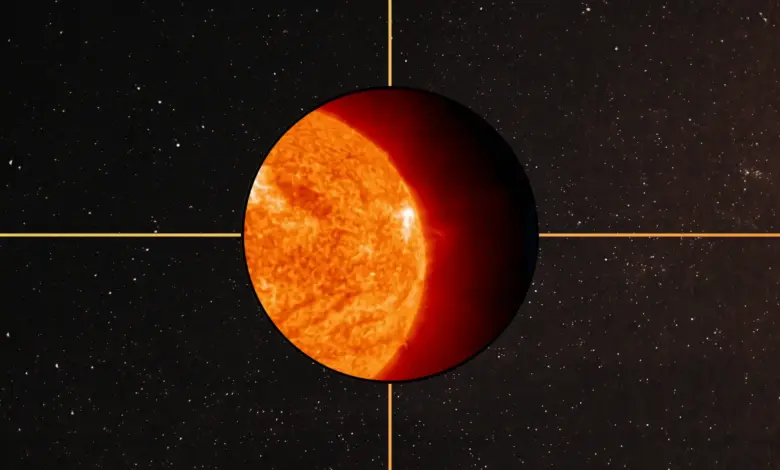
The active region was identified as AR4419, positioned on the sun’s western limb. A NOAA Space Weather Prediction Center update described an X2. 5 flare as a strong event observed near the northwest solar limb, appearing to originate just northwest of active Region 4419. Solar physicist Ryan French said these were the strongest solar flares seen in 78 days, which places the outbreak in a clear short-term context rather than as an isolated flash.
What If the Coronal Mass Ejections Stay on the Edge?
The flares appear to have been accompanied by coronal mass ejections, or CMEs, which are large expulsions of plasma and magnetic field from the sun. Because the source region sits near the sun’s edge, the current assessment is that the CMEs are unlikely to head directly toward Earth. Still, forecasters are modeling the paths, and a glancing blow remains possible.
If that happens, the most likely effects would be geomagnetic storm conditions and vivid aurora displays rather than the radio blackout pattern caused directly by flare radiation. That difference matters. The radio disruptions came from radiation reaching Earth and ionizing the upper atmosphere. The CME question is separate and depends on how the plasma cloud travels after launch.
What Forces Are Reshaping the Space-Weather Picture?
Three drivers are standing out:
- Solar activity timing: two X-class flares in seven hours show how compressed major activity can be.
- Geography of the source region: AR4419 is on the western limb, which reduces the odds of a direct hit from any associated CME.
- Atmospheric response: when flare radiation reaches Earth, it ionizes the ionosphere and can absorb or distort shortwave radio signals.
That last point is the reason radio systems are vulnerable during strong flares. Under normal conditions, high-frequency radio waves bounce through the ionosphere and travel long distances. During a strong flare, the lower layers become more ionized, making the environment denser and more disruptive to communication. NOAA says that can weaken, distort, or completely absorb signals.
What Happens Next for Forecasters and Stakeholders?
The best case is straightforward: the CMEs remain off-target, radio conditions stabilize, and Earth avoids additional disruption beyond the brief blackouts already seen. The most likely case is continued monitoring, with the sunspot region rotating out of view and any further impacts limited to short-term radio effects or a minor geomagnetic response. The most challenging case would involve a more direct-than-expected CME connection, bringing stronger geomagnetic disturbance and broader visibility of auroras.
For airlines, radio-dependent operators, and space-weather watchers, the near-term lesson is not panic but preparation. For spacecraft and astronauts, the broader reminder is that solar activity can change quickly, and high-intensity eruptions can matter even when the source is near the limb. For the public, the immediate impact is likely to stay in the communications layer rather than become a wider crisis.
The key takeaway is that solar flares are not just bright events on the sun; they are capable of producing immediate, measurable effects on Earth’s radio environment. With more monitoring still underway, the next shift will depend on how the associated CMEs behave and whether the active region delivers anything further before it rotates away. For now, the signal is clear: solar flares are back at the center of the space-weather story, and the next few updates will matter.