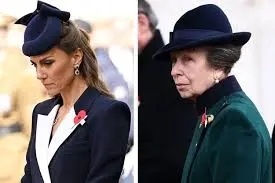
Anne, Princess Royal, helped place a wreath at Wellington Arch on a day built around remembrance, yet the most revealing detail was not the ceremony itself. It was the scale of the loss being marked: more than 100, 000 troops died in the failed Gallipoli campaign, a figure that turns a solemn annual service into something much larger than pageantry. The day’s rituals honored sacrifice, but they also exposed how carefully this history is still managed in public life.
What is the central question behind these ceremonies?
The public ceremony raises a simple but important question: what is being remembered, and what is being left to the margins? The answer, based on the official proceedings, is that Anzac Day was presented as a shared act of remembrance across Britain, Australia, and New Zealand, with military families, diplomatic representatives, and royal figures all placed within the same frame. Anne, Princess Royal, attended the dawn service organized by the New Zealand and Australian high commissions, while Princess Catherine took part in related commemorations elsewhere in London. The structure of the day suggests a deliberate effort to unify memory around service, sacrifice, and alliance.
Verified fact: the dawn service at Wellington Arch concluded with the national anthems of the United Kingdom, New Zealand and Australia, and the Whitehall memorial included a minute’s silence after the last post. Those details matter because they show the day was not only ceremonial but also diplomatic and military in tone. Informed analysis: the message was less about individual grief and more about a collective narrative of duty, one that places royal attendance at the center of national remembrance.
How was the memorial message constructed in public?
The Whitehall tribute used a sequence of symbols to shape the mood. Reverend Dr Lyndon Drake recited from The Fallen by Laurence Binyon. A Royal Marines Portsmouth Road Band trumpeter played the last post. A one-minute silence followed. The high commissioners for New Zealand and Australia, Hamish Cooper and Jay Weatherill, then walked in tandem to lay their wreaths. Each element reinforced the same theme: remembrance as choreography, with military and civic roles closely aligned.
Princess Catherine’s earlier wreath added another layer to that narrative. The ring of poppies and white flowers was described as depicting the feathers of the Prince of Wales’ crest, and the note signed by Catherine and Prince William paid tribute to “soldiers who made the ultimate sacrifice for our freedom. ” The wording frames the dead not only as casualties of war but as guardians of a wider cause. The same ceremony also included singing the hymn O God Our Help in Ages Past before men and women in military uniforms marched off Whitehall to Westminster Abbey for the commemoration and thanksgiving service.
Anne, Princess Royal, appeared within this broader pattern of state remembrance, where symbol, music, and procession carry equal weight. The service at Wellington Arch was not an isolated event; it fit into a network of commemorations held across New Zealand, Australia, and on the Gallipoli peninsula in Turkey on Saturday morning.
Why does Gallipoli still shape the public story?
Gallipoli remains the historical anchor of the day. The campaign was part of a British-led effort to defeat the Ottoman Empire and aimed to secure a naval route through the Dardanelles from the Mediterranean Sea to Constantinople, now Istanbul, in Turkey. It failed, and it lasted into 1916. The number of dead — more than 100, 000 troops — gives the commemorations their emotional force, but it also explains why the language around the day is so disciplined and respectful.
Verified fact: the Royal Family posted about Anzac Day as one that honours members of the Australian and New Zealand Army Corps who served and died in all wars, conflicts and peacekeeping operations. Informed analysis: that wording broadens the frame beyond Gallipoli, allowing the day to serve as a continuing national and transnational reminder rather than a single historical anniversary.
There is also a geographical spread to the memory. Services were held in Villers-Bretonneux in the Somme region of France, where Australian units helped defend during World War One, and commemorations took place in Wellington Arch, Whitehall, Westminster Abbey, New Zealand, Australia, and Turkey. The pattern shows that Anzac remembrance is not confined to one site or one nation. It is a coordinated act of international memory.
Who benefits from the shared ritual of remembrance?
The beneficiaries are visible in the ceremony itself. The royal household gains a role at the center of Commonwealth-linked commemoration. The high commissions reinforce their national visibility in London. Military families are given a formal place within the service. And the governments and institutions involved project continuity, unity, and respect across borders.
Yet the same structure can narrow the public view. When royal attendance, military music, diplomatic wreaths, and ceremonial readings dominate the stage, the history can become more polished than the conflict that produced it. That is not a challenge to the sincerity of the tribute; it is a reminder that public memory is always curated. Anne, Princess Royal, stood within a tradition that emphasizes dignity and continuity, but the deeper meaning of the day still rests on the scale of the loss being honored.
The account of the day leaves little room for ambiguity about purpose. It was a solemn act of remembrance, not a political statement. Still, the evidence shows a carefully managed public ritual in which national identity, military sacrifice, and royal presence are tightly woven together.
The necessary public reckoning is not about disputing the tribute. It is about insisting that commemorations remain grounded in the full weight of the history they invoke. If the dead of Gallipoli are to be honored properly, then the scale of the failure, the nature of the sacrifice, and the international reach of the memory must remain visible every time Anne, Princess Royal, appears at an Anzac Day service.