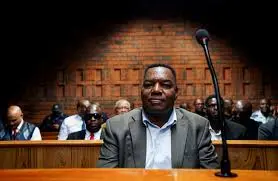
South Africa has entered another uneasy moment in its policing crisis after President Cyril Ramaphosa placed national police commissioner Fannie Masemola on precautionary suspension. The move came after Masemola appeared in court on four counts linked to a contested health tender, turning what might have been a narrow procurement dispute into a wider test of institutional trust. For South Africa, the case is no longer only about one contract. It is about whether the police service can remain stable while its top leadership is again pulled into criminal proceedings.
Why the South Africa police leadership crisis matters now
Ramaphosa said the suspension was driven by the seriousness of the charges and the central role of the national commissioner in the fight against crime. The president said the police service must be capable, ethical and effective, and must retain the confidence of the people of South Africa. Masemola is the third South Africa police chief to face a criminal investigation while in office, and his suspension follows a pattern that has repeatedly unsettled the service. The court case is tied to a tender awarded in 2024 to Medicare24 Tshwane District, which was meant to provide health services to the police and was later cancelled in May 2025.
What the tender case reveals about oversight
Masemola faces four counts of breaching the Public Finance Management Act, the law that governs how taxpayers’ money is spent. He is alleged to have failed in oversight duties connected to the awarding of a controversial $21m health contract, a matter that has since become the subject of a criminal investigation. He denied the charges in court and said the law must take its course. In the broader South Africa context, the significance lies in how a procurement dispute has widened into a question about internal controls, executive responsibility and the consequences of weak oversight in a force already under pressure.
The case also reflects the scale of the fallout. Since the contract was cancelled, a dozen senior police officers have been formally charged over their role in the awarding of the tender. They have been accused of colluding with businessman Vusimuzi “Cat” Matlala, who has also been charged with corruption. None of them has yet been asked to plead. Masemola is the only one among them who has not been charged with corruption, but the distinction has not insulated him from the political damage that now surrounds the case.
South Africa and the pressure on police credibility
The decision to suspend Masemola rather than keep him in office during the case shows Ramaphosa’s effort to contain further erosion of trust. Yet it also leaves the service in a delicate position. Lt-Gen Puleng Dimpane, who has been the police service’s chief financial officer since 2018 and has been in the force for almost 20 years, has been appointed acting commissioner. Her elevation offers continuity on paper, but her appointment has already drawn scrutiny because she oversaw police finances during the period when the alleged corruption took place. She has previously denied any involvement in corruption.
This is one reason the South Africa police leadership issue is more than a personnel change. The criminal case overlaps with the Madlanga Commission, which was set up by Ramaphosa to examine corruption in the police force and the alleged infiltration of the criminal justice system by criminal and corrupt elements. That overlap raises the stakes: the commission is investigating the environment that allowed these allegations to surface, while the court process focuses on the charges against Masemola.
Expert and institutional perspectives on the fallout
Ramaphosa framed the suspension as an attempt to preserve stability and continuity. He said he had agreed with Masemola that precautionary suspension was necessary pending the conclusion of the case. The president also declined, at this stage, to launch a separate inquiry into Masemola’s fitness for office, though he left open the possibility of revisiting that decision depending on how the criminal process develops.
The institutional strain is also reflected in the wider chain of suspensions and acting appointments. Police minister Firoz Cachalia is already serving in an acting position after Senzo Mchunu was placed on suspension as the Madlanga Commission unfolds. Deputy national commissioner for crime detection Lt-General Shadrack Sibiya is also under suspension. Together, these changes show how deeply the leadership of South Africa’s policing structure has been affected.
Regional and national consequences for South Africa
The immediate impact is administrative, but the wider effect is political. A police service operating under repeated leadership disruption risks losing momentum in crime-fighting, while public confidence can weaken further if allegations of corruption keep reaching the top. The hearing has already widened into a test of whether disciplinary and criminal accountability can move faster than the damage caused by scandal. Dimpane’s role will now be watched closely, especially because she inherits a service already under intense scrutiny and a budgetary record that has become part of the debate.
For South Africa, the larger question is whether this suspension becomes another temporary reset or a point at which police governance starts to recover. The answer will depend on the court process, the commission’s findings and whether the institution can prove that ethical leadership is still possible after yet another blow.
As the case moves forward, South Africa is left with a difficult question: can a police service under so much scrutiny restore confidence before the next crisis arrives?