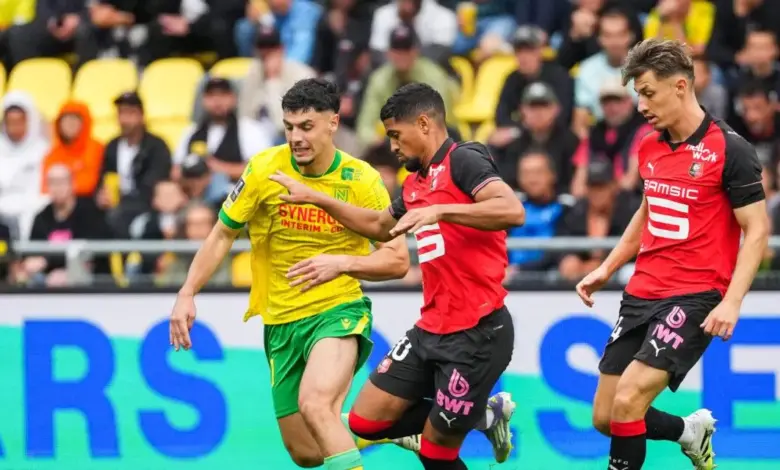
In Rennes – Nantes, the game felt tense from the first whistle, with one team chasing Europe and the other trying to stay alive in the top flight. By the final moments, that contrast had become impossible to ignore, as a single late strike changed the mood inside the stadium.
How did Rennes turn pressure into a decisive result?
Rennes began by controlling the match against a regional rival sitting near the bottom of the table. That early pressure quickly turned into an opening goal when Mousa Al-Tamari earned a penalty after being played in behind and brought down by Anthony Lopes. Esteban Lepaul converted from the spot in the 9th minute, giving Rennes the start it wanted.
But Nantes responded with energy and created danger of its own. Nicolas Cozza came close twice from set pieces, first with a header stopped by Brice Samba and then with a missed chance from point-blank range. Rennes then had its own scare as Abdelhamid Aït-Boudlal was tested repeatedly before Ignatius Ganago produced an equalizer with a composed 20-meter lob. By halftime, the match had already shifted from control to chaos.
Why did Rennes – Nantes matter so much in the table?
The stakes made every duel feel heavier. Rennes entered the match in the race for Champions League qualification, while Nantes was fighting for survival. That wider pressure framed every attack, every foul, and every defensive recovery. Rennes needed the points to keep hope alive in the chase for Europe, and Nantes needed a result to ease the strain at the other end of the table.
The second half reflected that urgency. Rennes threatened on the break through Al-Tamari, while Nantes repeatedly found openings inside the Breton box. Mohamed Kaba was denied by a goal-line intervention from Quentin Merlin before Brice Samba kept out a header. The match stayed open until the very end, when Valentin Rongier, a player formed at La Jonelière, scored with a disguised left-footed effort in stoppage time.
What did the late winner say about the match?
Rongier’s goal was more than a simple finish. It was the moment when Rennes turned sustained pressure into a result, and it came from a player with a direct connection to Nantes. He did not celebrate against his former club, but the impact was clear: Rennes had taken a major step in its pursuit of the upper places, and Nantes was left staring at a dangerous gap.
The match also underlined how fine the margins were. A possible sending-off for Deiver Machado was reviewed, but the referee kept the original yellow card decision. Rennes coach Franck Haise reacted strongly because, with one team reduced to 10, the game might have opened up more easily. Instead, it remained balanced until the closing seconds, when one masked shot settled it.
Who shaped the derby beyond the scoreline?
Rongier stood out in midfield with a performance that matched the occasion. He touched the ball 54 times, completed the match as the top ball-winner with seven recoveries, and won nine of his ten duels. He was central to Nantes’ play and also a source of several clear chances through his set pieces. Even in defeat, he left a mark on the game.
For Rennes, the result carried meaning beyond the scoreboard. The team can still look upward before its next trip to Lyon on Sunday, while Nantes leaves with a problem that has become harder to ignore. In a derby built on pressure, narrow escapes, and a late finish, Rennes – Nantes became a portrait of where both clubs stand: one reaching, one resisting, and one moment deciding everything.