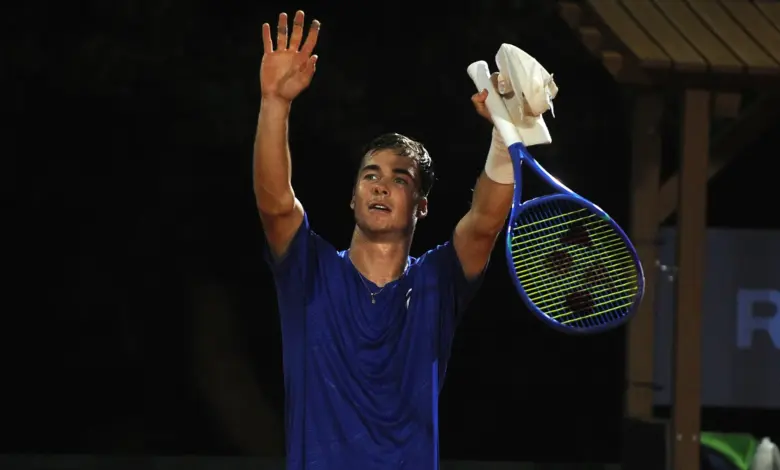
Under the lights in Madrid, vilius gaubas kept finding a way back. The Lithuanian faced Rei Sakamoto in a match that stretched across 3 hours and 24 minutes, and every set demanded the same patience: hold serve, absorb pressure, and wait for one more opening that never truly came.
In the end, that persistence carried him into the main draw of the ATP Masters event in Spain, a result built less on a single swing of momentum than on a string of narrow escapes and calm responses at the right moments.
How did vilius gaubas win such a long match?
He won it point by point, set by set, in one of the most evenly balanced contests of the week. Gaubas beat Sakamoto 7: 6 (7: 5), 6: 7 (5: 7), 7: 6 (7: 4) in the qualification final, and neither player managed to convert a break point during the match.
That detail explains much of the tension. With no breaks of serve, the match repeatedly returned to fine margins in tiebreaks, where every missed first ball or cautious return carried extra weight. Gaubas finished with 8 aces and 45 winners, numbers that reflect both his serving strength and his willingness to take chances when the match was most fragile.
What does this result mean for the Madrid tournament?
For Gaubas, the win means a place in the main draw of the Madrid ATP Masters tournament, where players compete for 1000 ranking points. His opponent in the first round will be determined after the draw ceremony.
The result also adds concrete rewards. The qualification-final victory brings Gaubas 30 ATP ranking points and 21, 200 euros. In a sport where a single match can shift both ranking position and schedule, those gains matter as much as the headline result itself.
The wider setting adds weight to the achievement. Madrid is not just another stop on the calendar; it is an event where the level rises quickly, and every qualifying round can feel like a final before the real tournament even begins. For a player ranked ATP-124, earning a place in that field is a statement of competitive stability as much as one of form.
Where does this fit in Gaubas’s recent run?
Gaubas had already shown control in the previous round, when he defeated French player Arthur Gea 6: 2, 6: 4 in the qualification semifinal. That earlier match was far more straightforward, but the final required a different kind of skill: staying composed when the score refused to separate the two players.
The contrast between the two matches tells a fuller story. One was efficient and clean; the other was a three-set test of nerve. Together they show a player capable of adjusting to different rhythms and different forms of pressure within the same event.
vilius gaubas now moves into the main tournament with the kind of momentum that can matter in the opening round, even before the draw reveals who waits next.
Why does this victory matter beyond one scoreline?
Because in tennis, endurance is not only physical. A match of this length tests concentration, timing, and trust in routine. It also leaves a mark on the player’s week: recovery time shortens, stakes rise, and the next match arrives with less margin for error.
For Lithuanian tennis, the outcome keeps Gaubas visible on one of the sport’s bigger stages. For Gaubas himself, it is a reminder that progress often comes through matches that are tight enough to turn on a few seconds of composure. Madrid will now show whether that kind of resilience can travel one round further.
As the court emptied after another tiebreak, the scoreline still felt almost too balanced for a winner to emerge. Yet vilius gaubas left with the one thing that mattered most: a place in the main draw, and another chance to turn pressure into progress.