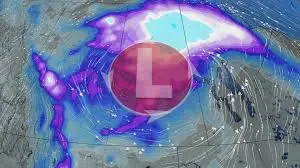
A Saskatchewan snow storm is now emerging as one of the most disruptive late-season weather events on the Prairies, with a slow-moving system expected to bring heavy, wet snow, strong winds, and sharply reduced visibility. The combination of Arctic air, blocking patterns, and a lingering low-pressure system is setting the stage for hazardous travel and possible infrastructure strain. For southern communities, the immediate issue is not just accumulation. It is the overlap of snow, wind, and timing that could turn routine spring movement into a prolonged disruption.
Spring storm patterns are turning dangerous
The storm is expected to intensify over southern Manitoba by Thursday before retrograding westward into Saskatchewan on Friday, then easing through the weekend. That movement matters because it lengthens the period of impact rather than concentrating it into a short burst. A Saskatchewan snow storm of this type can keep roads treacherous for longer, especially when strong winds continue to lift and blow fresh snow across open stretches of highway. Forecast details point to 30–50+ cm in parts of Saskatchewan and Manitoba, with northern and less populated areas most exposed to the deepest totals.
For southern Saskatchewan, including Prince Albert, Saskatoon and Moose Jaw, the expected range is 10–25 cm by evening, while Regina is more likely to see rain, with some wet snow possible later. That split is important: the storm is not uniform, and the danger depends heavily on location, temperature, and wind exposure. In other words, the same Saskatchewan snow storm can create slushy roads in one city and near-whiteout conditions on a highway only a short distance away.
Why travel and infrastructure face the greatest risk
Strong winds of 60–90 km/h are forecast alongside the snow, creating blowing snow and visibility drops that could make travel especially difficult on Yellowhead Highway and Highway 1 west of Saskatoon and Regina. Sharp temperature drops of nearly 20 C across southern Alberta and Saskatchewan are also expected early Thursday, adding another layer of stress to roads and commutes. Heavy, wet snow can weigh on trees and utility lines, which is why power outages remain a concern when gusts combine with fast accumulation.
The risk is amplified by timing. The storm is expected to hit during the work week, when commuters, freight traffic, and regional travel are all more active. A Saskatchewan snow storm with this structure does not just slow vehicles; it can disrupt the movement of goods, delay emergency response, and leave rural areas isolated if blowing snow closes roads or creates sudden visibility loss. Narrow, intense snowsqualls may also develop near Edmonton, Cold Lake, and Prince Albert, with 5–15 cm possible in a short time and abrupt travel deterioration.
Moisture relief, but with a costly tradeoff
There is a second side to the forecast. The precipitation will provide much-needed moisture as the region prepares for fire season. That benefit is real, but it does not cancel the immediate hazards. A Saskatchewan snow storm that delivers widespread snow in spring can help replenish dry ground, yet the gains come alongside short-term disruption and the possibility of localized damage from heavy, wind-driven snow. The weather pattern also includes a mix of rain, snow, and strong winds across Alberta, Saskatchewan, and Manitoba through the end of the work week, making the event both useful and dangerous.
What the wider Prairies are facing
The broader Prairie impact is significant because the system is not confined to one province. Northern Saskatchewan and Manitoba are expected to face prolonged heavy snowfall, accumulating 30–50+ cm by Friday before easing into Saturday. That means the region could spend several days dealing with the same storm footprint, with impacts shifting as the low-pressure system moves and then loops back west. For areas on key corridors, especially the Yellowhead Highway and Highway 1, the combination of snow load, blowing snow, and uncertain snowsquall placement makes planning difficult.
Officials and road users are being urged to check road conditions before heading out. The need is straightforward: when the atmosphere is unstable, a Saskatchewan snow storm can change quickly from a nuisance into a safety issue. Even where snowfall totals are lower, the wind can make the difference between passable roads and dangerous ones.
Expert forecast signals and the outlook ahead
One forecast analysis notes that the system is slow-moving, which is the core reason the storm is so disruptive. Another highlights the role of atmospheric blocking, which will slow the storm’s movement and keep impacts in place longer than a fast-moving front would. Those dynamics help explain why the snowfall forecast is so broad and why travel impacts may continue even after the heaviest precipitation shifts.
With heavy snow, strong wind, and a wide corridor of impact, the central question is whether this Saskatchewan snow storm becomes remembered more for its disruption or for the moisture it leaves behind. The answer may depend on how much snow falls in the hardest-hit areas and how long roads remain affected once the storm begins to pull away.