The meteor shower is back in focus as the Lyrid display moves toward its next peak, giving skywatchers a short window to plan around timing, location, and light conditions. For readers in Australia and beyond, the key question is not whether the event returns, but how much of it can be seen from a given place and at a given hour.
What Happens When the Lyrids Reach Their Window?
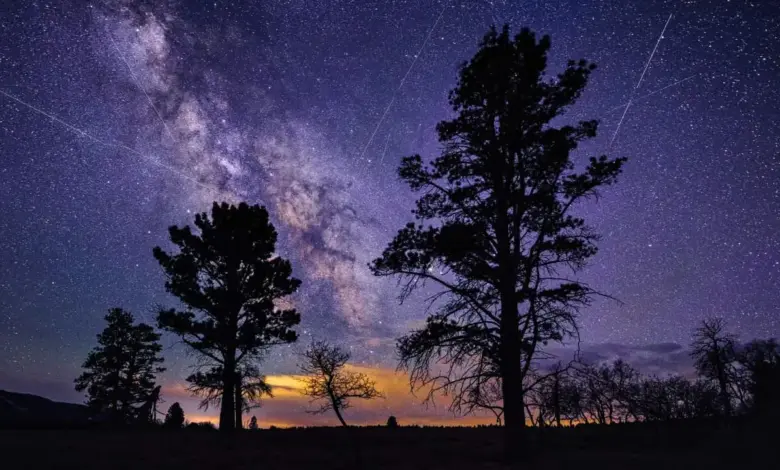
The Lyrid meteor shower has been recorded for more than 2, 700 years and reoccurs every April. In 2026, it is active from April 16 to April 25, with peak activity around 4 p. m. EDT on April 22, which places the peak during the day for viewers in the United States. That means the most practical viewing opportunity comes before dawn on April 22, when the sky is darkest and the radiant is better placed for observation.
The shower is tied to the debris stream left behind by Comet C/1861 G1 Thatcher. As Earth passes through that trail, particles enter the atmosphere and burn up as meteors. The trail is not static: Dr Laura Driessen, from the University of Sydney, noted that Earth passes through a slightly different part of the stream each year and that the debris slowly disperses over time, which helps explain why the number of meteors varies from one year to the next.
What If You Are Watching From Australia?
For Australian skywatchers, the general rule is clear: the farther north you are, the better the display is likely to be. Professor Jonti Horner, from the University of Southern Queensland, said Brisbane is more likely to see a stronger show than Melbourne, while Sydney and Perth should experience similar displays. Regional and rural locations also have an advantage because light pollution is lower than in major cities.
The best viewing conditions do not require special equipment, but they do require patience and a dark location. The Lyrids should be easiest to spot away from artificial city lights, and the clearest view may come after eyes have had time to adjust.
| Viewing factor | What the context indicates |
|---|---|
| Best time | 2 a. m. AEST, with meteors possible from 11 p. m. to 6 a. m. |
| Best conditions | Dark skies away from artificial lights |
| Regional advantage | Better visibility in rural and regional areas |
| Southern hemisphere note | Not as vivid as in the northern hemisphere |
What If the Sky Is Clear but the Show Is Modest?
Even in ideal conditions, expectations should stay grounded. Professor Horner said an experienced observer in a very dark location might see at most about six or seven, perhaps eight meteors in an hour. In other conditions, the count could be lower. The Australian viewing window is therefore about making the most of a limited event rather than expecting a dramatic storm.
There is still a clear reason the Lyrids remain significant. Driessen pointed to Chinese records of the meteor shower being seen in 687 BC, underscoring that people have been watching this event for centuries. That long record adds context to an event that is now observable through both historical memory and modern skywatching practice.
What Happens Next for Skywatchers?
The most realistic forecast is simple: the meteor shower will reward people who plan for darkness, time their viewing for the early morning hours, and choose a location with minimal light pollution. The best case is a clear rural sky in the northern half of Australia, where the display should be easier to see. The most likely case is a modest but worthwhile show, with a handful of meteors visible over an hour. The most challenging case is a bright urban setting or poor weather, which would reduce visibility sharply.
For readers deciding what to do, the practical lesson is to treat the event as a narrow window rather than an all-night spectacle. Go early, go dark, and look north if you are in Australia. The meteor shower will not offer certainty, but it does offer a repeatable pattern: a predictable April return, a better chance away from city lights, and the strongest viewing in the hours before sunrise.