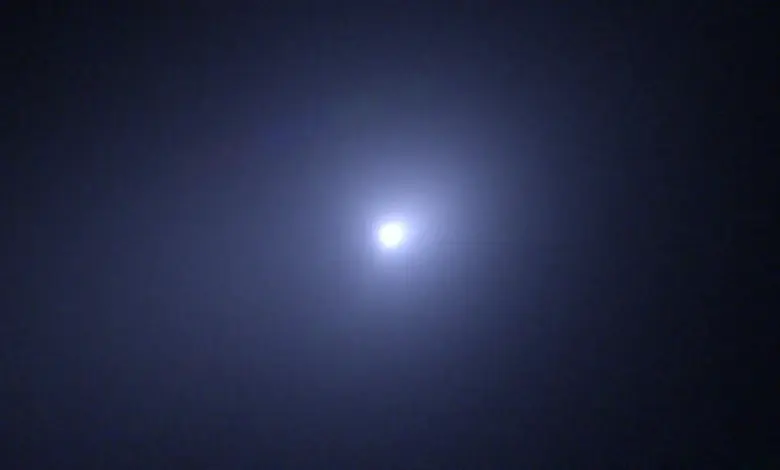
The interstellar comet 3i atlas has done more than cross the solar system and fade from view. Its pass near the Sun appears to have altered its chemistry, giving researchers a rare chance to compare material from another stellar system with comets formed here. That matters because this visitor is only the third object ever identified from beyond our solar system. In a field where direct samples are impossible, every change in its coma becomes a clue to how distant planet-forming environments may differ from our own.
Why 3i atlas matters now
The latest observations focused on the comet as it moved close to the Sun last fall. Researchers used the Subaru Telescope in Hawaii on Jan. 7, 2026, to examine its coma, the gas envelope around the nucleus. By studying its colors, the team estimated the ratio of carbon dioxide to water and found that this ratio had changed since the comet’s closest solar approach on Oct. 29, 2025. That shift is important because it suggests the outer layers of the interstellar comet 3i atlas may not match its interior makeup.
This is not just a chemical footnote. A coma forms when frozen material escapes from a comet’s core and solar heating causes ice to turn directly into gas. When the chemistry changes after perihelion, the most natural reading is that different layers are being exposed. In other words, the comet may preserve a layered record of the environment where it formed, rather than a uniform sample of one distant world.
What the changing coma suggests
The analysis points to a deeper structural story. If the internal chemistry differs from the exterior, then the comet may have evolved under conditions unlike those in the early solar system. That makes the interstellar comet 3i atlas especially valuable to researchers trying to reconstruct how planetesimals and planets form in a range of stellar systems. It is not just an object passing through; it is a fragment of another system’s history moving through ours.
Another set of observations came from a spacecraft tracking the comet after its close approach to the Sun. Those measurements showed ice turning into water vapour at a rate equivalent to 70 Olympic swimming pools a day. In practical terms, that means the comet was active enough to shed material rapidly, yet still precise enough for scientists to measure composition in detail. The result strengthens the case that deep-space missions can observe objects that are too distant or too faint to study well from Earth.
Expert views and mission value
Yoshiharu Shinnaka, team leader at the Koyama Space Science Institute in Japan, said that applying techniques developed for solar system comets to interstellar objects now makes it possible to compare comets from inside and outside the solar system and explore differences in composition and evolution. He added that with full-scale survey telescopes in the coming years, many more interstellar objects are expected to be discovered, offering a deeper understanding of how planetesimals and planets formed across a wide variety of stellar systems.
The European Space Agency’s Planetary Defence team has drawn a second lesson from the same comet. Their view is that observations of the interstellar comet 3i atlas by a spacecraft on its way to Jupiter show how deep-space missions could help provide early warning signs of potential threats. That matters because some asteroids are too far away to be seen immediately from Earth, leaving little time for response if they later turn out to be hazardous.
Broader implications for planetary defence and astronomy
The broader value of the finding is twofold. First, the comet offers a rare sample of chemistry from beyond the solar system, one that can be measured only while it remains within reach. Second, it demonstrates that spacecraft already traveling through the solar system can contribute to planetary defence by monitoring difficult targets from unconventional vantage points. The same methods used to study a visiting comet could one day help identify a danger before it becomes a crisis.
For astronomy, the significance is just as clear. Every confirmed observation of the interstellar comet 3i atlas narrows the gap between theory and evidence. It shows that objects arriving from other star systems can be tracked, analyzed, and compared with local comets in real time. The challenge now is whether future survey telescopes and deep-space missions will turn this one-off encounter into a repeatable scientific method.
For now, the comet is leaving the solar system for good. What it leaves behind is not only a trail of gas and dust, but a question that may shape the next generation of observations: how many more interstellar visitors will arrive, and what else will they reveal before disappearing forever?