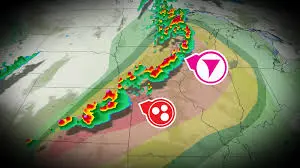
Weather storms tornadoes have now moved from a forecast threat to a visible crisis across the central United States. In the span of a few days, the pattern has delivered softball-sized hail, intense winds, tornado warnings, and outages affecting more than 100, 000 customers across the Midwest.
Verified fact: The U. S. Storm Prediction Center has received more than 700 hail reports at least the size of a quarter so far this week, including more than 250 reports of hail the size of golf balls or larger. Informed analysis: The scale of those reports suggests this is not a single storm event but a sustained severe-weather episode with repeated impacts.
What is being missed in the headline count?
The central question is not whether the storms are severe. It is what their cumulative impact reveals. The most visible danger is the possibility of strong tornadoes and hailstones as large as softballs, but the less obvious story is the length of time communities have stayed under threat. Repeated rounds of severe thunderstorms have hit the northern and central United States since Tuesday, and the risk extended into Canada at times, where the first tornado warning of the year was issued in southern Ontario on Wednesday morning.
Verified fact: A swath of extremely large hail fell in southern Wisconsin on Tuesday evening, and a trained spotter near Madison reported a hailstone around 10 cm, or 4 inches, in diameter. Informed analysis: When hail of that size is appearing alongside tornado watches and damaging wind gusts, the public impact goes beyond isolated damage reports and becomes a regional infrastructure problem.
How large is the storm footprint?
The footprint is unusually broad. On Friday, a level 4 out of 5 moderate risk for severe weather was in effect for portions of the Plains states, while tornado watches stretched across the central United States through Friday evening. Those watches warned of potentially strong tornadoes, hailstones as large as softballs, and very strong wind gusts possibly in excess of 115 km/h. At the peak of the outbreak, more than 50 million people across a 1, 500-mile stretch were under threat of severe weather.
Verified fact: More than 100 tornado warnings were issued as storms carved a destructive path from the Plains into the Midwest. Multiple tornadoes were reported, and communities across several states were left assessing damage after powerful winds and possible tornadoes tore apart structures, downed trees and powerlines, and left neighborhoods in disarray. Informed analysis: That combination indicates a fast-moving emergency in which the warning system is being tested repeatedly across a very large area.
Who is carrying the heaviest burden?
The burden is falling hardest on states already dealing with widespread disruption. Illinois has more than 60, 000 customers in the dark, with McLean County alone accounting for over 20, 000 outages. Missouri is reporting upwards of 35, 000 outages statewide, and Wisconsin has more than 15, 000 customers without electricity. More than 100, 000 customers across the Midwest remained without power after the storms battered the region.
Verified fact: Storm impacts have also included heavy rainfall and rising floodwaters in parts of southern Ontario. Informed analysis: The convergence of power loss, structural damage, flood risk, and repeated severe alerts means recovery will not be measured only by downed trees and broken roofs, but by how long essential services remain strained.
Why does this pattern matter beyond one weekend?
One reason this event stands out is timing. It is unusual to have so much sustained severe weather across the northern United States this early in the season. Intense severe thunderstorms usually remain in the southern tier of the United States during the early spring months, with the bulk of tornado activity more often expected in Mississippi or Alabama at this time of year. Based on climatology, hailstones larger than 5 cm are usually concentrated in northern Texas and Oklahoma during the middle of April.
Verified fact: The storms have already moved across northern and central states, and additional rounds of severe weather are expected into Saturday. Informed analysis: The persistence of this pattern matters because it shifts the focus from a single outbreak to a longer period of exposure, where even communities that have not yet been directly hit remain under credible threat.
The public takeaway is straightforward: weather storms tornadoes are not ending with the latest round of warnings. The evidence points to a prolonged severe-weather corridor that has already produced dangerous hail, multiple tornado reports, and widespread outages, while still leaving room for more damage into Saturday. The immediate demand now is transparency about the continuing risk, clear communication from official agencies, and rapid support for the communities already counting the cost of weather storms tornadoes.