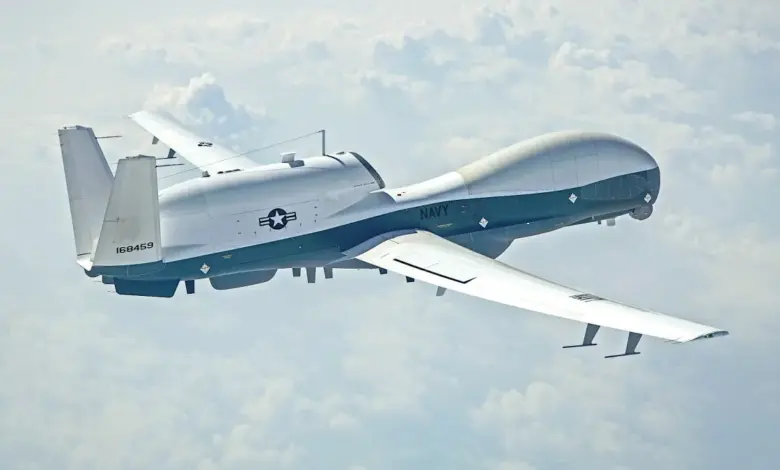
The confirmation of the mq 4c triton crash closes one mystery but opens another: how did a high-altitude Navy surveillance aircraft disappear so abruptly during a mission over the Persian Gulf? The U. S. Navy has now listed the loss as a mishap on April 9, yet the circumstances remain undisclosed. What is clear is that no personnel were injured, and the missing drone now sits among the service’s most expensive aviation losses, raising fresh questions about the risks surrounding persistent reconnaissance in a tense maritime corridor.
What the Navy has confirmed about the mq 4c triton crash
Naval Safety Command’s publicly available mishap summary includes a brief entry stating: “9 Apr 2026 (Location Withheld – OPSEC) MQ-4C crashed, no injury to personnel. ” That language matters because it confirms the event while withholding the location for operational security. The incident is classified as a Class A mishap, a category used for events causing more than $2 million in damage, or involving death or permanent disability.
The classification alone signals scale. Navy budget documents last placed the unit price of an MQ-4C at just over $238 million, making this one of the service’s costliest uncrewed assets. As of 2025, the Navy had 20 MQ-4Cs in service and planned to acquire seven more. In practical terms, the mq 4c triton crash is not just a single-aircraft loss; it affects a small fleet designed for long-endurance maritime surveillance.
Why the disappearance drew attention so quickly
Before the mishap was confirmed, the aircraft had vanished from online flight-tracking systems after a sharp and sudden descent from a typical cruising altitude of around 50, 000 feet to below 10, 000 feet. The drone had been returning to Naval Air Station Sigonella in Italy after a surveillance mission over the Persian Gulf and Strait of Hormuz. At the time, the aircraft was also broadcasting transponder code 7700, a general declaration of an in-flight emergency. There were also reports that it may have initially squawked 7400, a code used when a drone loses connection with ground controllers.
That sequence left a narrow factual picture: an emergency signal, a rapid descent, and then disappearance from tracking data. What it does not provide is a verified explanation. The Navy has not offered one, and U. S. Central Command declined comment. The result is a confirmed loss with no public account of whether the cause was mechanical failure, systems malfunction, weather, or another non-public factor.
Operational stakes and the intelligence value of recovery
The concern surrounding the mq 4c triton crash extends beyond cost. The MQ-4C carries an active electronically scanned array radar, electro-optical and infrared cameras, and electronic support measures designed to collect signals intelligence passively. Navy and contractor work has also focused on upgrading the drone’s signals intelligence suites in recent years. If any of those systems were recovered largely intact by another actor, the loss could carry intelligence consequences beyond the airframe itself.
There is no indication that the drone went down because of hostile fire. Still, the location of the wreckage matters because recovery can shape both technical insight and propaganda value. The aircraft was last tracked in international airspace over the Persian Gulf, heading in the direction of Iran, but there is no evidence it crashed there. That distinction is important: suspicion and proximity do not amount to confirmation.
Expert views and broader regional consequences
Analytically, the confirmed loss underscores how exposed long-endurance surveillance missions can become when operating over contested waters. The drone had been supporting a broader posture in and around the Strait of Hormuz, where the American military said it would begin clearing naval mines and blocking maritime traffic from entering or leaving Iranian ports. CENTCOM also said the blockade involves more than a dozen U. S. warships, as well as drones and surveillance aircraft. In that environment, the mq 4c triton crash highlights the fragility of systems built for persistence and reach.
John F. Plumb, Assistant Secretary of Defense for Space Policy, has previously described the value of resilient sensing in demanding operational settings, while the Naval Safety Command’s mishap system itself shows how the service formally frames such losses when facts are still limited. The open issue now is not only what happened on April 9, but whether the Navy can sustain the same surveillance tempo after losing such a costly platform.
For now, the mq 4c triton crash stands as a confirmed but unexplained setback: an expensive aircraft gone, a mission interrupted, and a region still demanding continuous eyes in the sky. If the location remains withheld and the cause remains unknown, how much more will be revealed about the risks facing future surveillance flights over the Persian Gulf?