The central fact in the gianni infantino story is not a match, a trophy, or a slogan. It is a request: FIFA management has discussed whether its president should ask President Donald Trump for a full moratorium on ICE raids across the United States during the World Cup this summer.
What is FIFA not saying out loud?
The question is whether a global sports body is trying to protect a tournament, or whether it is trying to manage a political relationship that has already become unusually close. Verified fact: senior FIFA management discussed with Gianni Infantino the possibility of a direct appeal to Trump. The reported aim is to reduce the risk that immigration enforcement will overshadow matches, fan travel, and the image of the tournament.
That concern is not abstract. The World Cup begins on June 11, and this year’s matches are set to be cohosted by the United States, Canada, and Mexico. Eleven US cities, including Atlanta, Miami, and Los Angeles, are scheduled to host games. The scale matters because the pressure is not only about stadium security; it is also about the movement of visitors across host cities and surrounding areas.
Why does ICE keep coming up before kickoff?
Verified fact: Trump administration officials have previously signaled that Immigration and Customs Enforcement could have a presence at World Cup games. In February, ICE acting Director Todd Lyons told a committee in the House of Representatives that his agency would be on the ground for World Cup events, while declining to commit to pausing operations at matches.
That position has fueled anxiety inside and outside FIFA. Some member federations, especially in Europe, privately raised concerns from fans about possible ICE activity during the tournament. FIFA was also alerted to human rights complaints from fans during the Club World Cup last summer, including alleged sightings of Customs and Border Protection and ICE officials at stadiums. A Department of Homeland Security spokesperson denied that enforcement took place and called those claims fear-mongering.
Here the gianni infantino question becomes more than an internal management issue. It becomes a test of whether FIFA can secure basic conditions for attendance without appearing to negotiate over domestic policy from a position of political convenience.
Who benefits if Infantino makes the call?
Informed analysis: the clearest beneficiary would be FIFA itself, which wants the tournament to proceed without fear of raids, disruption, or reputational damage. Trump would also benefit if the event is framed as both economically valuable and tightly controlled. The White House, through spokesperson Davis Ingle, said the event will generate billions of dollars of economic impact and hundreds of thousands of jobs, while praising Trump’s leadership and stressing safety and security.
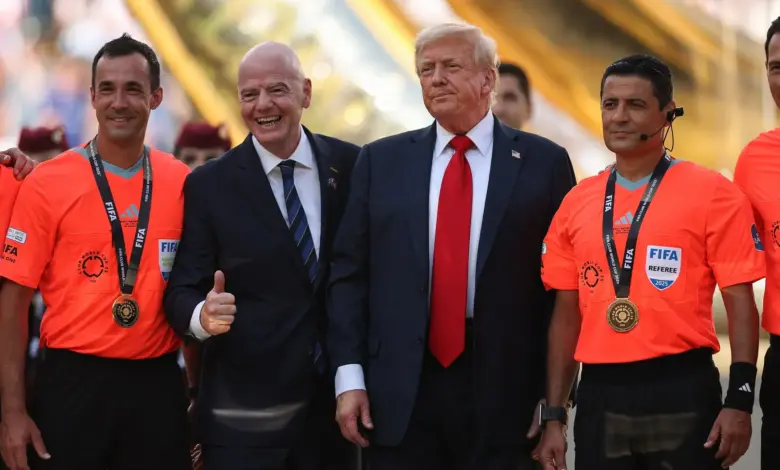
Infantino’s relationship with Trump is the other critical factor. Verified fact: he attended Trump’s pre-inauguration rally, Trump’s inauguration, several Oval Office appearances, Board of Peace meetings, and a UFC event in Miami. He also opened a FIFA office in Trump Tower in New York City and awarded Trump FIFA’s inaugural Peace Prize in December. That pattern has led some senior FIFA executives to believe Infantino may have leverage to request policy adjustments that would help the World Cup run smoothly.
Still, there is no confirmation that the request has been made. The reporting indicates only that FIFA leaders discussed the possibility and that the scope of the request expanded from venues around the 11 host cities to the cities themselves. The uncertainty is itself revealing.
What does the wider record suggest?
Verified fact: Trump’s mass-deportation push has already created a climate of fear around immigration enforcement. The context includes concentrated ICE incursions into American cities, deadly clashes tied to the crackdown, and congressional and labor concerns that World Cup activity could be caught in the sweep. The issue is not whether security exists; it is how broadly that security is defined.
Informed analysis: FIFA now faces a choice between silence and intervention. Silence may preserve the appearance of neutrality, but it risks leaving fans, teams, and host cities uncertain about how immigration enforcement will operate during the tournament. Intervention could reduce that uncertainty, but it would also show that FIFA is willing to rely on Infantino’s relationship with Trump to shape the conditions around a global event.
The deeper contradiction is hard to miss. FIFA wants the World Cup to feel universal, welcoming, and commercially seamless. Yet the institution is discussing a request that depends on one president’s personal ties to another, at a moment when immigration enforcement remains politically charged and publicly visible. That is not a minor side story; it is the backdrop to the tournament.
Until FIFA clarifies its position, gianni infantino will remain at the center of a question the organization would rather not answer in public: whether the world’s biggest football event can be insulated from the politics of raids, enforcement, and presidential favor. The demand now is simple — transparency, a clear commitment to attendees, and a public explanation of what FIFA is asking for, and why, before gianni infantino turns private leverage into public policy pressure.