Arleigh Burke-class Destroyer USS Harvey C. Barnum Jr. Commissioning Carries a 1,800-Guest Message

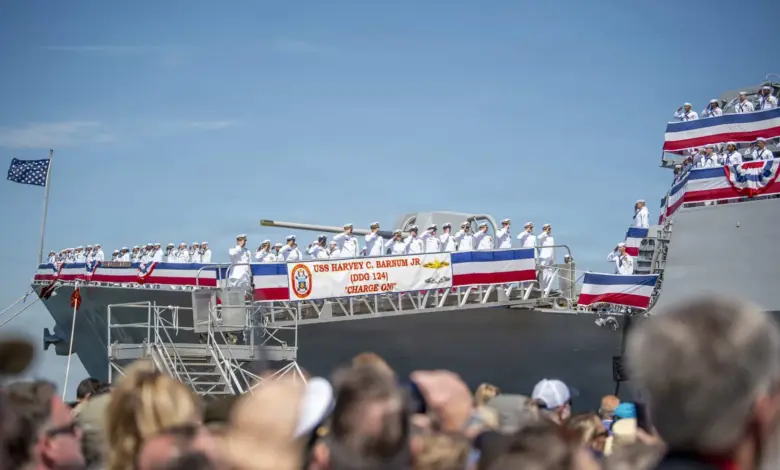
The Arleigh Burke-class destroyer USS Harvey C. Barnum Jr. entered commissioned service on April 11, 2026, but the ceremony at Naval Station Norfolk was about more than a hull number. With about 1, 800 guests in attendance, the event linked a new warship to a living namesake, a Medal of Honor legacy, and a broader Navy message about readiness. That combination made the commissioning less a routine milestone than a public statement about what the fleet wants this ship to represent now.
Commissioning Day at Naval Station Norfolk
USS Harvey C. Barnum Jr. (DDG 124) was welcomed into the fleet before senior military leaders, Sailors, Marines, veterans, and family members. Secretary of the Navy John C. Phelan served as the principal speaker, joined by Vice Chief of Naval Operations Adm. James W. Kilby and Commandant of the Marine Corps Gen. Eric M. Smith. The ceremony included naval honors, music from “The President’s Own” United States Marine Band, and the traditional moment when the ship’s sponsor, Martha Hill, ordered the crew to “man our ship and bring her to life. ”
The scene underscored how a commissioning can function as both ritual and signal. In this case, the ship’s entry into service was framed as a visible step in the Navy’s effort to place more capable ships in the water. Phelan described the vessel as combat power rather than symbolism, while also tying the moment to what he called the President’s Golden Fleet. The Arleigh Burke-class destroyer, in that setting, became a marker of capability as well as ceremony.
Why the Arleigh Burke-class Destroyer Matters Now
The significance of the Arleigh Burke-class destroyer in this context lies in the overlap between timing, naming, and messaging. The Navy emphasized that ships like Harvey C. Barnum Jr. help sustain global warfighting advantage and defend the homeland. Kilby said the need to build great warships remains clear, and Smith drew a line between the ship’s crew and the warrior ethos expected to deter aggression and win when it matters most.
This matters because the commissioning came with unusually strong attention on identity and mission. The ship is the first to bear the name of Vietnam War Medal of Honor recipient U. S. Marine Corps Col. Harvey C. Barnum Jr., making the vessel a direct extension of a specific legacy rather than a generic tribute. In practical terms, that places the destroyer at the intersection of service tradition and strategic signaling, where the name of the ship is meant to reinforce the purpose of the force it joins.
A Living Legacy Aboard the Ship
One of the most unusual elements of this Arleigh Burke-class destroyer story is that Barnum was present for the commissioning of the ship named in his honor. That rare detail gives the event a family dimension that is not often part of fleet milestones. Chief Petty Officer Courtney Dion, Barnum’s niece, serves aboard the ship as a hospital corpsman and senior medical department representative. She said contributing to the mission and readiness is a once-in-a-lifetime opportunity and that representing his legacy is one of the best things she can do.
Dion’s connection also gives the ceremony a human scale. Before boot camp 16 years ago, she asked her uncle for advice and followed it without drawing attention to the family link. Her comments show how the ship’s commissioning reaches beyond ceremony into personal service, with family history and professional duty meeting on the same deck. She said her family had waited since 2016 for the commissioning and that the occasion brought overwhelming excitement and pride.
Expert Views and Strategic Implications
Phelan used the event to argue that the ship adds to more than symbolism. He said Harvey C. Barnum Jr. represents rebuilding American maritime dominance by putting more capable ships in the water and strengthening the industrial base. Kilby, meanwhile, framed the destroyer as part of the Navy’s global warfighting advantage, while Smith emphasized the values Barnum’s career represents: courage under fire, selfless sacrifice, and commitment to mission and others.
Those remarks matter because they show how the commissioning was intended to communicate several messages at once. The ship honors a Medal of Honor recipient, but it also signals continuity between the Marine Corps legacy attached to Barnum’s name and the Navy crew that will carry it forward. Martha Hill said the ship’s crew transforms the vessel from steel into something living, and that line captures the deeper meaning of the day: a warship enters service not only with equipment, but with expectations.
Regional Reach and Broader Fleet Messaging
At the regional level, the commissioning at Naval Station Norfolk placed the ship within one of the Navy’s most visible operational settings. At the broader level, the ceremony reinforced the idea that a modern fleet depends on both material strength and narrative coherence. A named destroyer can become a tool of memory, morale, and institutional identity. In this case, the Arleigh Burke-class destroyer links a living family member, a historical act of valor, and a current readiness message into one public event.
The broader question is whether this kind of commissioning can do more than celebrate a new hull. It can shape how sailors understand service, how families understand sacrifice, and how the public understands the purpose of a fleet being asked to stand watch, deter aggression, and prepare for conflict if needed. That is why the Arleigh Burke-class destroyer matters well beyond the pier where it was commissioned.