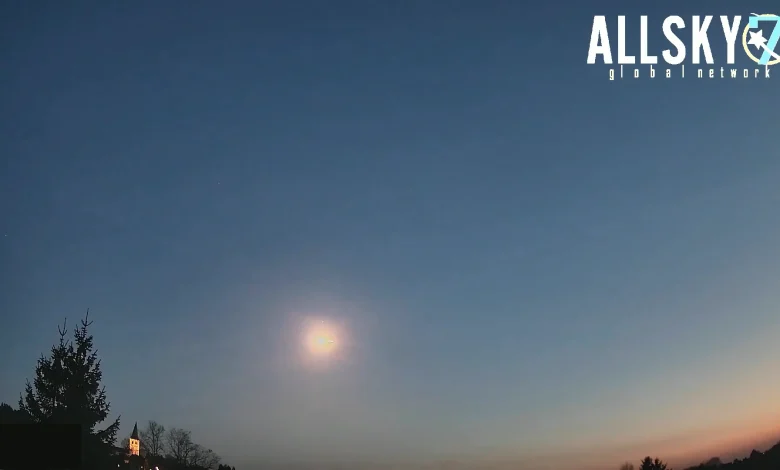
In a widely seen sky event, a meteorite produced a very bright fireball that crossed parts of western Europe and fractured, sending fragments that struck at least one house in Koblenz-Güls. The European Space Agency (ESA) is using camera networks and recordings to reconstruct the event, and its Planetary Defence team currently assesses the object to have been up to a few metres in diameter.
Background and immediate context
At approximately 18: 55 CET (17: 55 UTC) on Sunday, observers in Belgium, France, Germany, Luxembourg and the Netherlands watched a fireball move from the southwest to the northeast, glow for roughly six seconds and leave a visible trail before breaking apart. The phenomenon was captured by dedicated meteor cameras, including members of the European AllSky7 fireball network, as well as by mobile phones and other cameras. Some witnesses reported that the event was audible from the ground.
Fragments from the breakup reached the surface: at least one house in the German town of Koblenz-Güls was struck by small pieces identified as meteorites. There are no reports of physical injury.
Meteorite fragments and what the data show
ESA’s Planetary Defence team is compiling all available recordings and sensor information to estimate the pre-entry size and trajectory. They currently assess the incoming object to have been up to a few metres in diameter, a scale that matches networks of dedicated cameras detecting bright fireballs. Objects in this size range, the agency notes, strike Earth from once every few weeks to once every few years.
The timing and direction of the fireball suggest the object was likely not visible to the large-scale telescope sky surveys that routinely scan the night sky. ESA explains this limitation is common for small objects approaching from brighter, daytime regions of the sky, or from around dusk. To date, there have only been 11 successful detections of natural space objects prior to their atmospheric entry, underlining the difficulty of early detection for meters-scale bodies.
Expert perspectives, detection gaps and broader impact
ESA’s Planetary Defence activities are both investigatory and forward-looking: the team is analysing the recordings to reconstruct trajectory and fragmentation and is working to improve pre-impact detection rates through projects such as the Flyeye asteroid survey telescope. The agency has stated: “They currently assess it to have been up to a few metres in diameter. ” The same team also highlights frequency expectations: “Objects in this size range strike Earth from once every few weeks to once every few years. “
Regionally, the event produced multi-country eyewitness data and camera records that are valuable for trajectory reconstruction and fragment recovery. The documented strike on a Koblenz-Güls house demonstrates how fragments from such breakups can reach the surface and cause local property damage even when no injuries occur. International camera networks and mobile-device footage together provide the raw material planetary defence teams need to map the path and to seek recovered fragments for laboratory analysis.
Looking ahead: detection, recovery and unanswered questions
ESA has signalled it will provide further updates as new information becomes available, and the Planetary Defence team is using the event to refine detection and response procedures. The combination of multiple recordings and the on-ground impact will offer empirical data to test models of atmospheric entry and fragmentation for meter-scale objects. How quickly recovered fragments can be located and analysed will determine what the scientific community learns about the object’s composition and origin.
Will improved camera networks and dedicated survey projects close the gap that allowed this meteorite to arrive unannounced, and will recovery work turn this unexpected strike into a clearer picture of small-object risks?