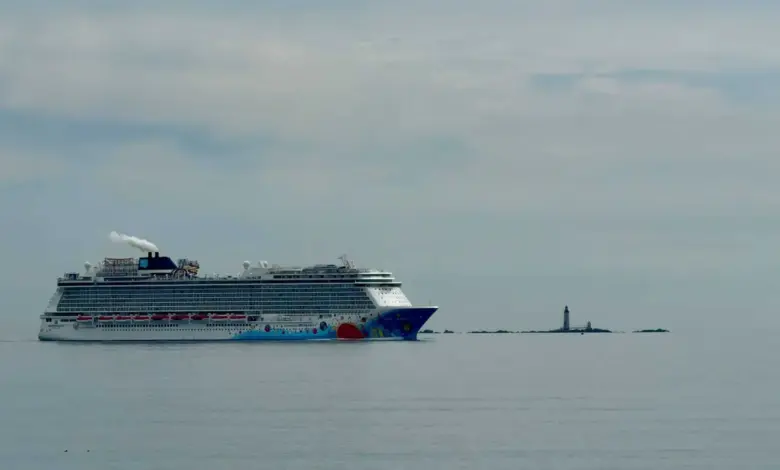
The cruise ship crew member overboard incident became a turning point overnight as Coast Guard teams suspended the search near Wellfleet, Massachusetts, after a reported fall from the Norwegian Breakaway on its way to Boston. The case now stands at the intersection of a fast-moving rescue response, a delayed return to port, and the uncertainty that follows when a person is seen entering the water but the outcome remains unresolved.
What Happens When the Search Is Suspended?
Rescue crews began searching early Sunday after a man overboard announcement was made to passengers. The U. S. Coast Guard Sector Southeastern New England received a report that the crew member was seen on a security camera falling from the ship into the ocean about 12 miles off Wellfleet, near the Cape Cod coast. A helicopter arrived just after 1: 15 a. m. ET, and a crew from Coast Guard Station Provincetown also joined the effort.
By late Sunday morning, the search was suspended pending new information. The ship later arrived at Boston’s Black Falcon Terminal just before noon ET, and passenger embarkation was delayed because of the late arrival. The crew member’s identity has not been released, and officials have not stated what caused the fall. The cruise line said it immediately informed the Coast Guard Marine Rescue Coordination Center and that a coordinated search and rescue operation was initiated.
What If the Response Becomes the New Standard?
The cruise ship crew member overboard case highlights how quickly modern onboard systems can trigger a large-scale response. In this incident, the ship reportedly relied on security camera footage, a shipwide announcement, launched lifeboats, and a turn back toward the last known position. That sequence suggests a response model built around speed, coordination, and maritime protocol rather than improvisation.
There is also a broader pattern in the background. The Cruise Lines International Association has said that between 2009 and 2019, about 19 to 25 overboard incidents were reported annually worldwide. That figure does not explain any one event, but it shows why overboard situations remain a serious operational concern for cruise operators and rescue authorities alike. The current case also shows the practical limit of search efforts: even with helicopters, rescue boats, and station crews involved, the search can still be suspended if there is no new information to guide the next phase.
What If the Outcome Remains Unknown?
For the people on board, the immediate impact was emotional and logistical. A passenger described hearing loud noises after waking in the cabin, while another passenger said a man overboard announcement was issued and lifeboats were launched. The cruise line told passengers that the vessel remained engaged in search and rescue efforts overnight and into the early morning, and that those efforts required the vessel’s full attention before the voyage could safely resume toward Boston.
For stakeholders, the effects are uneven:
- Passengers: face delays, uncertainty, and a stark reminder of how quickly a voyage can change.
- Crew and family members: carry the immediate human cost of an unresolved emergency.
- Coast Guard teams: must balance rapid search action with the point at which further searching becomes unproductive without new information.
- Cruise operators: face scrutiny over safety procedures, response timing, and communication.
The strongest signal is not panic, but fragility: even with clear protocols, the final outcome can remain unknown for hours or longer.
What Should Readers Understand Next?
The immediate lesson from the cruise ship crew member overboard incident is that maritime emergencies can evolve quickly and then stall just as fast when evidence runs out. The operational response was extensive, the vessel returned to Boston, and the search was suspended after a coordinated effort near Cape Cod. What comes next will depend on whether new information emerges, and on whether investigators can determine how the crew member fell from the ship.
For now, the most important takeaway is measured: the facts point to a serious emergency, a prompt search, and an unresolved result. In cases like this, uncertainty is part of the story, and the public record may not fill every gap immediately. The cruise ship crew member overboard remains the central fact, even as the next phase depends on what authorities learn, if anything, in the hours and days ahead.