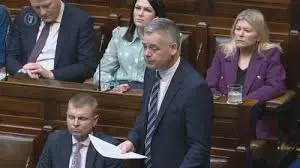
energy bills are back at the center of a political clash in the Dáil after Sinn Féin argued that Budget 2026 failed to protect workers and household budgets. The dispute has sharpened around whether the Government acted early enough as prices rose and supports were reduced. Mary Lou McDonald used the Government’s own comments to push her case, while Micheál Martin defended the budget as a targeted response. With another budget still months away, the argument now is less about one line in public spending and more about who felt the strain first.
Why Budget 2026 is under fresh pressure
The immediate trigger was Minister for Public Expenditure Jack Chambers saying the previous budget “didn’t give workers a break. ” Mary Lou McDonald seized on that remark in the Dáil and said it confirmed what Sinn Féin had been arguing for months: that the €9. 4 billion package “did absolutely nothing for ordinary working people” and “left them worse off. ”
Her central political claim is not only that the Government missed the mark, but that the impact was felt in day-to-day household spending. She said families were facing rising prices, mounting bills and pressure on electricity, rent and grocery costs. In that framing, energy bills are not a side issue; they are part of a wider squeeze on household finances that shaped the political reaction to Budget 2026.
Government defense and the numbers in dispute
Micheál Martin rejected the accusation that money had been withheld from workers. He said the Government channelled resources into areas of greatest need and pointed to public expenditure rising by 8. 6 per cent. His argument was that this was not a failure to act, but a choice about where support should go.
Chambers also pointed to decisions taken “for other sectors of the economy, ” including hospitality and developers. He added that any tax package would need to become “a priority” in the context of Budget 2027. That remark matters because it signals the Government is already being pushed to think beyond short-term firefighting and into the structure of the next budget cycle.
Still, the political dispute remains over whether those choices were enough for working households now. Sinn Féin’s line is that the Government’s approach may have satisfied some fiscal priorities while leaving others exposed to energy bills and other living costs. The Taoiseach’s reply was equally blunt: the Government had not ignored families, he said, and had put significant investment into housing and infrastructure while also increasing State pensions by €10 and child support payments.
The cost-of-living argument beneath the headlines
At the heart of the clash is a difference in how each side defines relief. For Sinn Féin, the test is whether support reaches ordinary workers before pressure becomes severe. For the Government, the test is whether spending is sustainable and directed where it can do the most overall good. Those are very different political measures, and Budget 2026 exposed that gap.
McDonald said the budget had “driven the deep anger and frustration” now visible across the State. She argued that support was withdrawn while families were under severe pressure, leaving people “high and dry. ” That phrase captured the political message of the day: that the cost-of-living crisis is not being measured only in abstract economic terms, but in what people can actually pay each month.
The Taoiseach responded that the war in the Middle East was a significant factor in fuel price increases. That point does not settle the debate, but it shows the Government is linking some of the pressure on energy bills to external shocks rather than domestic budget choices alone. The result is a political argument over responsibility: how much comes from global conditions, and how much from the design of Budget 2026 itself.
What Pearse Doherty’s challenge adds to the dispute
The same wider cost-of-living tension surfaced in separate Dáil exchanges involving Sinn Féin’s Pearse Doherty and Tánaiste Simon Harris. Harris told the Dáil the Government could not introduce budget measures every week, while also saying it did not rule out taking further action. He defended Ireland’s response to the fuel crisis as “the largest or second largest in the EU, and twice the European average. ”
That defense matters because it shows the Government is likely to frame its response as substantial by European standards, even while facing pressure to do more. Sinn Féin’s challenge is designed to cut through that argument by focusing on whether households feel supported in practical terms, especially when energy bills continue to weigh on family budgets.
What this means for households and Budget 2027
The political stakes now point toward Budget 2027, with Chambers already saying a tax package will need to be a priority. For households, that means the debate has shifted from whether Budget 2026 was generous enough to whether the next budget will be asked to repair the gap. For the Government, the challenge is to defend its record while showing it understands the pressure on wages, bills and basic living costs.
For Sinn Féin, the opportunity is clear: keep the focus on workers who feel they were left behind. For the Government, the question is whether spending choices can be presented not just as prudent, but as visible relief. If energy bills remain a daily pressure point, can the political argument over support really wait until the next budget?