Aim Montreal is now at the center of a dispute that was building long before Thursday’s fire: a major blaze, a revoked operating permit, and repeated warnings about air pollutants that the City says had not been brought under control.
What happened at the site, and why did the City move now?
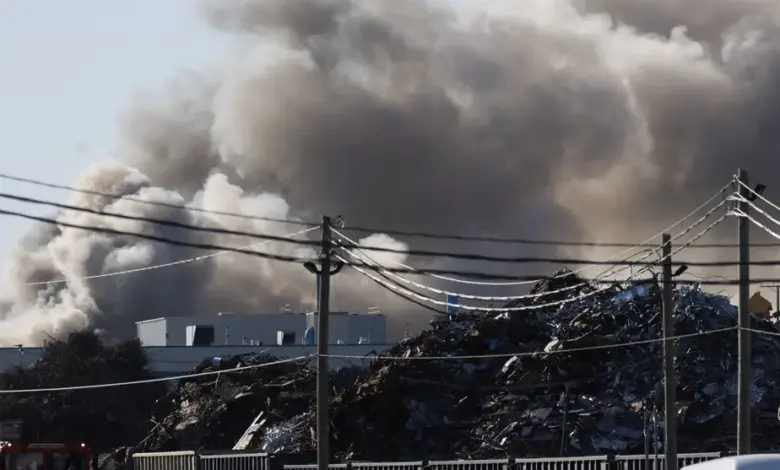
Verified fact: A major fire broke out Thursday morning at 9100, boulevard Henri-Bourassa Est, the headquarters site of American Iron & Metal in Montréal-Est. The Service de sécurité incendie de Montréal was alerted at about 5: 20 ET. About fifty firefighters were mobilized, and no injuries were reported, Annick Vaillancourt, spokesperson for the fire service. The fire involved waste and vehicles.
Verified fact: Hours later, the City of Montreal announced that it had revoked all operating permits for the company. The City said the decision was not tied to the fire, calling the timing a coincidence and saying the move had already been planned for public release around midday.
Analysis: The immediate blaze drew attention, but the administrative action had a separate foundation. The City says the core issue is not a single incident; it is a repeated failure to bring the site into compliance with environmental limits.
Why is Aim Montreal under pressure over pollution?
Verified fact: The City says that for years it had asked the company to meet standards. In May 2025, it requested a plan to comply with regulations and respect limit values for metals and particulates. The documents submitted by the company, the City said, did not demonstrate that process changes would allow the requirements to be met. The City also said the pollution-control equipment was insufficient to control particulates.
Verified fact: The City stated that recurrent exceedances of particulates and metals continued to be measured at the site boundary. Those measurements were part of the rationale for revoking the permits.
Analysis: That detail matters because it shows the dispute is not only about what was burning Thursday morning. It is also about what the site has been emitting over time, and whether the company’s proposed fixes were considered credible by municipal authorities.
What does the public-health response reveal?
Verified fact: The Public Health authority warned that air quality could be affected in several sectors of the city. In a separate warning, Santé Montréal said the disturbance was affecting air quality in several sectors and urged caution, especially for people with heart or respiratory conditions, young children, pregnant women, older adults, and outdoor workers.
Verified fact: Normand Voyer, professor of chemistry at Université Laval, said the black smoke contained particulate matter that can enter the lungs and is not filtered by the nose. He also said it was difficult to identify exactly what was in the smoke from a metal-recycling yard and warned that burning contaminants such as plastics could generate different toxic materials.
Analysis: The public-health message is not that every person will be harmed in the same way. It is that uncertainty itself is part of the risk: when the contents of the smoke are not clearly defined, caution becomes the only responsible guidance.
Who is implicated, and what are the stakes for Aim Montreal?
Verified fact: The company, also known as Fer et Métaux Américains, was founded in 1936 by Peter Black. The City’s move adds to a broader record of regulatory conflict. In October 2024, the municipality had suspended the permit for a particle-emitting piece of equipment, and that decision is now the subject of a lawsuit brought by the company. The company is also seeking to have part of a new regulation from the Communauté métropolitaine de Montréal invalidated, arguing that it is discriminatory, abusive, and unreasonable.
Verified fact: The federal government had already scrutinized the company for PCBs in a park in the borough of Anjou beside its Montréal-Est plant. An inspection from 2022 found scrap piles that included substances that could have come from opened, punctured, or crushed electrical capacitors. More recently, PCB concentrations were measured at more than 90 times the permitted value on 3 November and 23 times the permitted value on 4 June 2025.
Analysis: The company’s position is that the rules and enforcement actions are excessive. The City’s position is the opposite: that the site has repeatedly exceeded limits and that previous requests for a compliance plan did not solve the problem. Those are not abstract disagreements; they shape whether the site can keep operating under current conditions.
What should the public understand now?
Verified fact: The fire did not cause the permit revocation, but it exposed the same site under the same scrutiny. Citizens near the smoke reported strong odors and concern about what they had breathed in. Some said the smell resembled rubber, burned plastic, or metal. Others said they had not known the company was there until the incident drew attention.
Analysis: The deeper issue is not only one fire. It is the gap between the scale of the industrial activity at Aim Montreal and the confidence the public can place in the site’s environmental controls. When officials revoke all operating permits, when health authorities warn vulnerable people to stay cautious, and when prior pollution findings remain unresolved, the central question becomes whether compliance is being corrected in practice or only contested in procedure.
For now, the record points to a company facing escalating regulatory pressure, a city insisting the limits were repeatedly exceeded, and a public left to judge risk through smoke, odor, and official warnings. Aim Montreal is no longer just an industrial name in Montréal-Est; it is a test of how long repeated environmental alarms can be treated as manageable before they become decisive.