In Mother Mary, anne hathaway steps into the center of a story about fame, fracture, and the long road back to the spotlight. The film frames her as a pop star on the brink of a comeback, but the clothes, the music, and the relationship at the heart of the story all suggest something deeper than a return performance.
What is Mother Mary really about?
At its core, Mother Mary follows a singer trying to reclaim her place while facing the damage left behind in a creative friendship. Anne Hathaway’s character turns to her estranged friend Sam, played by Michaela Coel, now a hot fashion designer, for a special dress. The request is practical on the surface, but the film presents it as emotional repair as much as artistic collaboration.
That tension gives the story its human scale. The character is not only trying to look ready for a stage comeback; she is also trying to end the drama between herself and Sam. Iris van Herpen, the Dutch designer who created the film’s grand-finale gown, describes the film as a study of creative relationships, saying the dress becomes an expression of how one creative influences another and how identity can be lost or regained through that bond.
How do the costumes tell the story?
The costumes are built as part of the character arc, not decoration. Bina Daigeler, who oversaw the film’s costumes, says the task went far beyond sequins and star-ready bodysuits. When the audience first meets Mother Mary, her fame has already faded, and the wardrobe had to reflect that lost status while still keeping the character fashion-forward. Daigeler says the goal was to translate emotion into costume.
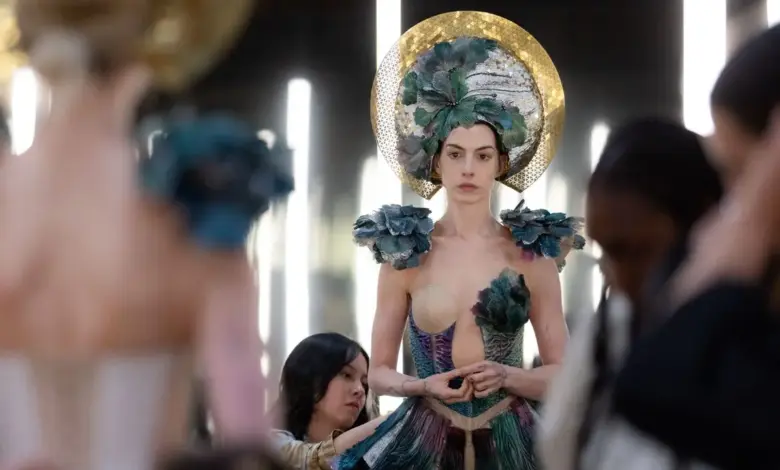
That approach shows up in the flashbacks, where Mother Mary appears in flowing capes, crystal-encrusted bodysuits, and halo-shaped headpieces. The look draws from real performers, including Beyoncé, Taylor Swift, Dua Lipa, and Madonna in the 1980s. Daigeler also references Alexander McQueen and John Galliano while building a style language distinct to the film. Even pieces that never reached the screen shaped the visual identity of the project.
For the production, costume design becomes a narrative system. It marks the shift from faded fame to constructed myth, and then toward something more exposed. In that sense, anne hathaway is not just wearing wardrobe; she is carrying the film’s argument about what stardom demands from a person.
How did the soundtrack shape Anne Hathaway’s performance?
The music in Mother Mary was developed with a similarly layered logic. David Lowery wrote the fictional pop star after studying the past 25 years in music, moving from references like Taylor Swift and Lorde toward a mood shaped by James Blake and Aldous Harding. The film’s soundtrack includes original pop tracks from Charli XCX and Jack Antonoff, while FKA twigs contributes a song that was not ultimately kept in the film.
Twigs appears on screen as a medium named Imogene, and she says she sent two songs to Lowery when he asked for more music. One of them, she says, matched a scene involving the dress Mary needs from Sam. Hathaway, meanwhile, entered the project with only early demos and without full knowledge of how the songs would land. She says her sound was low on the totem pole when the work began, because the character was still being built in layers.
Lowery says the emotional center of the film shifted as the haunted love story between Mary and Sam emerged. For him, the music stopped being only pop and began to reflect the intimate conflict between two women. That shift gives the soundtrack a double life: theatrical enough to support the diva mode, and intimate enough to reveal the fragility beneath it.
What gives the final look its meaning?
The film’s defining dress arrives at the end, when Mother Mary appears in the red, draped-organza frock made by Sam and realized in real life by Iris van Herpen. Van Herpen says the dress is less a garment than a vessel or spirit. She describes the design process as intuitive, shaped through draping and dyed red organza, with the dress meant to suggest transcendence.
That final image closes the loop on the character’s journey. Mother Mary is still a pop star, but the dress signals a different state of being: a passage through fame, loss, and self-recovery. In the film’s world, the comeback is not simply a return to the stage. It is a confrontation with identity, and a quiet question about whether reinvention can ever be separated from the people who helped shape it.
For anne hathaway, the role appears built around that tension. The glamour is loud, but the emotional stakes are quieter, and that contrast gives Mother Mary its pulse.