The latest South China Sea dispute is not unfolding around a missile launch or a new outpost, but around a poison that may have been used to damage the sea itself. The Philippines has accused Chinese fishermen of dumping cyanide near Second Thomas Shoal, saying the alleged act was designed to wipe out fish and pressure troops stationed on a grounded warship. China has rejected the claim outright, turning a marine-environment allegation into another test of political trust.
Why the South China Sea claim matters now
Manila says the alleged poisoning began last year around Second Thomas Shoal, part of the Spratly Islands. The reef is home to a small Philippine military outpost aboard the BRP Sierra Madre, a World War Two-era ship deliberately grounded in 1999 to reinforce the country’s claim to the territory. Philippine National Security Council assistant director-general Cornelio Valencia said the use of cyanide was intended to “kill local fish populations, ” depriving Navy personnel of a vital food source. He also warned of health risks for troops and possible damage to coral reefs that help support the vessel’s structural foundations.
That is what makes the case more than a fisheries dispute. In the South China Sea, control is measured not only by ships and patrols, but also by access to food, safe waters and the stability of tiny physical footholds. Manila says the navy and coastguard have been ordered to increase patrols, and that it plans to submit a report to the foreign ministry that could become the basis for a diplomatic protest.
What the evidence and the denials reveal
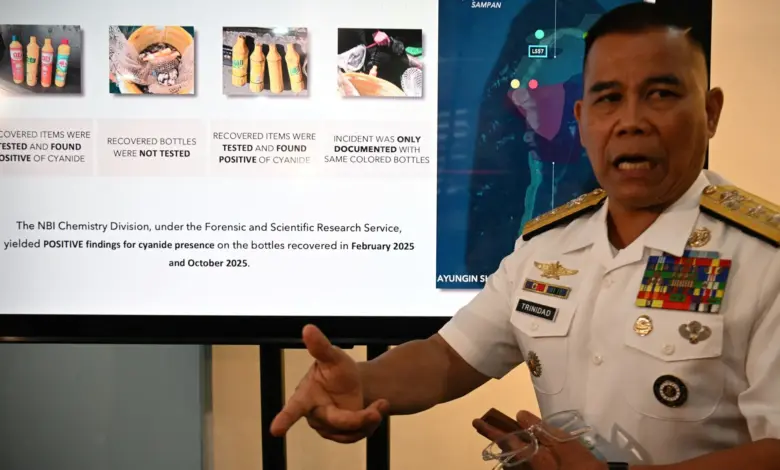
Philippine Navy spokesman Rear Adm Roy Vincent Trinidad said troops seized 10 bottles of cyanide from sampan boats allegedly launched from Chinese fishing vessels in February, July and October last year. He added that military personnel later spotted another sampan crew poisoning waters near the shoal last month, and that samples tested positive for cyanide. Those details give the Philippines a narrower, more concrete case than a general accusation of harassment. Still, the significance lies less in the chemistry than in the pattern: a disputed atoll, repeated incidents, and competing claims over what exactly happened at sea.
China’s response was equally forceful. Foreign ministry spokesman Guo Jiakin called the accusation “completely unbelievable and not even worth refuting, ” while dismissing Manila’s position as a “farce. ” Beijing says the Philippine side has “illegally harassed” Chinese fishing vessels engaged in normal fishing activities. The two narratives are incompatible, and that is precisely why the incident matters. In a maritime zone already defined by overlapping claims, even an allegation tied to marine pollution becomes part of a wider contest over legitimacy.
South China Sea tensions and the reef under pressure
The broader South China Sea dispute already includes China, the Philippines, Vietnam, Taiwan, Malaysia and Brunei. It is a vital shipping route, home to rich fishing grounds that support millions of livelihoods, and an area where more than half of the world’s fishing vessels operate. It is also believed to sit atop stores of natural resources and potential energy reserves. Against that backdrop, the alleged use of cyanide raises a second-order concern: even a localized environmental incident can ripple outward into food security, military logistics and diplomatic positioning.
There is also the reef itself. Philippine officials say the alleged cyanide could weaken the coral formations that help support the grounded ship at Second Thomas Shoal. That would make the issue not just about environmental damage, but about the physical integrity of a territorial marker. In practical terms, the reef is both ecosystem and structure, which means harm to one can undermine the other. That overlap gives the accusation unusual strategic weight.
Expert framing, diplomatic stakes and regional impact
No independent assessment has been presented in the context available here, so the claims remain contested. But the sequence of events shows how quickly a local incident can escalate when it touches a military outpost and a disputed maritime claim. The Philippines says the matter was raised with Beijing at a recent meeting, but no formal response was received. It now plans to escalate the issue through official channels, while China continues to treat the allegation as politically motivated.
The regional impact is wider than the shoal itself. If the allegation is treated as a pattern rather than an isolated event, it may harden positions at the very moment both sides have held high-level talks on preliminary oil and gas cooperation and confidence-building measures at sea. The Philippines has said limited coastguard cooperation does not include sensitive operational areas or joint patrols. That caution reflects how fragile the atmosphere remains.
For now, the South China Sea is once again being shaped by competing narratives: one side warning of sabotage, the other rejecting the claim as fabricated. The deeper question is whether either country can prevent a dispute over cyanide and fish stocks from becoming another irreversible step in a much larger maritime rivalry in the South China Sea.