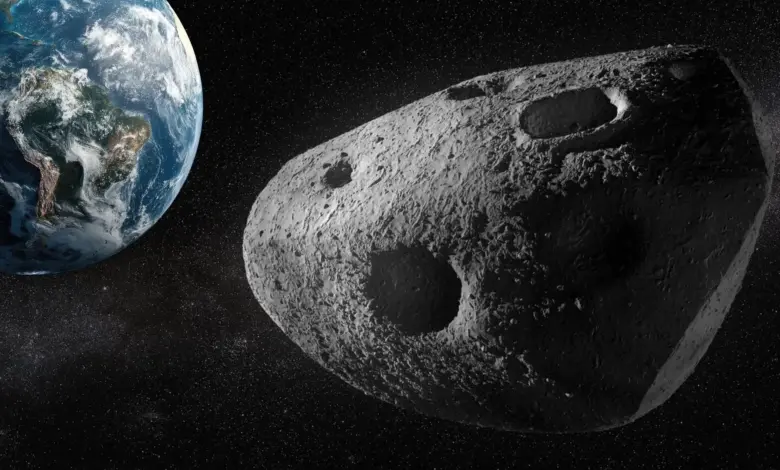
The number that matters most is not the size of the rock, but the distance: about 20, 000 miles from Earth’s surface. That is close enough to put asteroid Apophis inside the ring of geosynchronous satellites, and close enough to make April 13, 2029, a once-in-a-lifetime skywatching event.
What is not being told about asteroid Apophis?
The central question is simple: what should the public understand about a flyby that sounds alarming but is not a collision threat? Verified fact: scientists have ruled out any impact risk for at least the next 100 years. Informed analysis: the real story is not danger, but rare visibility. For observers in Europe, Africa, and western Asia, the object will appear for one night only, and the best view is expected around 4: 30 p. m. ET, when it reaches peak brightness.
By 5: 45 p. m. ET on April 13, 2029, asteroid Apophis is expected to reach its nearest point. At that moment it will pass closer than Earth’s geosynchronous satellites, a detail that turns this from a routine astronomical event into a public spectacle. The object’s brightness is estimated at magnitude 3. 1, which is bright enough to be seen with the naked eye from dark locations, but only in some places.
Why does this flyby matter to scientists?
Apophis was discovered in 2004 and was once linked to global concern because early calculations suggested a possible impact. That fear has since been removed by later observations and radar tracking. The remaining significance is scientific: the 2029 encounter offers a rare chance to examine how Earth’s gravity affects a large near-Earth object.
Verified fact: Apophis is classified as a potentially hazardous asteroid because of its size and proximity, not because it poses a current danger. It measures roughly 1, 230 feet across, or 375 meters, with estimates placing its width between 340 and 370 meters and its longest dimension beyond 450 meters. It is also described as an elongated, rocky, peanut-like body with a bi-lobate structure. In plain terms, it looks like two blobs joined together.
This is where the event becomes more than a stargazing moment. The close pass may help scientists study a stony asteroid made mostly of silicate rock and metallic nickel-iron, a reflective S-type asteroid that resembles LL chondrites. It is also a remnant from the early solar system, about 4. 6 billion years ago, and it rotates once every 30 hours while wobbling on a secondary axis.
Who benefits from the encounter, and who should be watching?
Scientific institutions benefit first. The flyby gives them a chance to observe a body that has traveled through space for billions of years and is expected to be permanently pushed into a wider Apollo-class orbit after the encounter. That shift matters because it is Earth’s gravity, not human planning, that will alter the object’s path.
The public benefits too, but in a different way: this is a rare naked-eye event that may be visible without a telescope from selected regions. That makes the encounter both accessible and unusual. For skywatchers, the value lies in timing and geography. For researchers, the value lies in measurement, trajectory, and the behavior of a spinning asteroid under close planetary influence.
Informed analysis: the most important implication is that asteroid Apophis demonstrates a larger truth about near-Earth objects. A name once tied to chaos can become a case study in precision, risk assessment, and observation. The flyby does not confirm a threat; it confirms how narrow the margin can be between fear, discovery, and scientific clarity.
What should the public take away from April 13, 2029?
The evidence points in one direction: asteroid Apophis will be close, bright, and scientifically valuable, but not dangerous. It will pass closer than the ring of satellites that support television, GPS navigation, and weather forecasts, and it will do so in a way that is visible to some observers for just one night. That combination is rare enough to deserve attention without exaggeration.
Accountability now means keeping the facts intact. The public should be told that the flyby is extraordinary, but that the risk has been ruled out. Scientists should be given room to study the encounter, and the public should be given clear, precise information about where and when the event can be seen. In the end, asteroid Apophis is not a warning of catastrophe. It is a reminder that the sky can still surprise us, and that careful observation is the best answer to uncertainty.