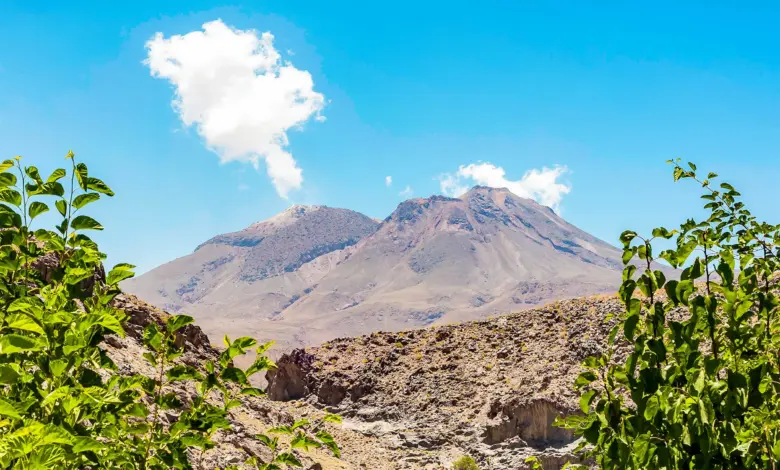
A volcano in southeastern Iran has nudged upward by about 3. 5 inches in 10 months, and that subtle movement has become the key signal that the system is stirring. The volcano is Taftan, and the new measurement matters because it suggests pressure is building near the summit even though it has not erupted in human history.
What Happens When a Quiet Volcano Starts to Rise?
The latest shift was detected with InSAR, a radar method that measures ground motion from space. Sentinel-1 satellites tracked the uplift day and night, through clouds, over a little more than ten months. The rise centered near the summit and has not fallen back, which points to pressure that has not yet been released.
Taftan is remote and does not have continuous GPS receivers on the ground, so satellite monitoring is the most practical way to follow changes in a place that is hard to instrument directly. Pablo J. González of the Institute of Natural Products and Agrobiology’s Spanish National Research Council is the senior author guiding the work. In this case, the signal is a measurement, not a label, and that distinction matters.
What If the Pressure Is Coming From Inside the Hydrothermal System?
The modeled source sits only 1, 600 to 2, 070 feet below the surface. That shallow depth points to gases moving and collecting inside a hydrothermal system, where hot water and gas circulate under a volcano. The team ruled out heavy rain and nearby earthquakes as triggers, which leaves internal processes as the more likely explanation for the deformation.
Deeper below Taftan lies a magma reservoir more than 2 miles down. That means the current push likely comes from gases above it rather than fresh magma reaching the surface. The pattern resembles a slow squeeze: the ground rose, then steadied as cracks opened and some gas found exit paths. Summit fumaroles show the system still vents gas, which supports the idea that Taftan is active in a limited but meaningful way.
What Happens Next for Taftan and the Region Around It?
For now, the strongest takeaway is not that an eruption is imminent, but that the volcano deserves close attention. Eruption records for the past 10, 000 years are scant, yet silence on paper does not mean a dead system in rock and gas. Volcanoes can idle for long stretches and then change in months, which is why scientists watch ground motion, gas, and heat, not only ash plumes.
| Scenario | What it would mean |
|---|---|
| Best case | Pressure eases slowly, gas finds stable pathways, and the uplift fades without further escalation. |
| Most likely | Taftan remains under watch, with internal gas movement continuing and the summit area responding in small, uneven changes. |
| Most challenging | Pressure continues to build in the shallow system, demanding closer monitoring for a sharper change in behavior. |
The main uncertainty is the source and pace of the pressure. One likely driver is gas building up in tight rocks and fractures. Another is a small pulse of melt that released volatile gases into the shallower plumbing. Both explanations fit the current deformation, and both keep the focus on monitoring rather than certainty.
For stakeholders, the winners are the scientists and agencies with access to satellite tracking, because they can observe a remote mountain that lacks continuous ground instruments. The people who live near Taftan are the group with the most to watch, since a quiet volcano can still change quickly. The losers would be anyone relying on a static label of dormancy to define risk, because the data now show a moving system, not a fixed one.
The lesson is straightforward: watch the measurements, not the myth of silence. Taftan is remote, but it is not inert, and the next phase will depend on whether pressure keeps rising, stabilizes, or opens new pathways inside the volcano. volcano