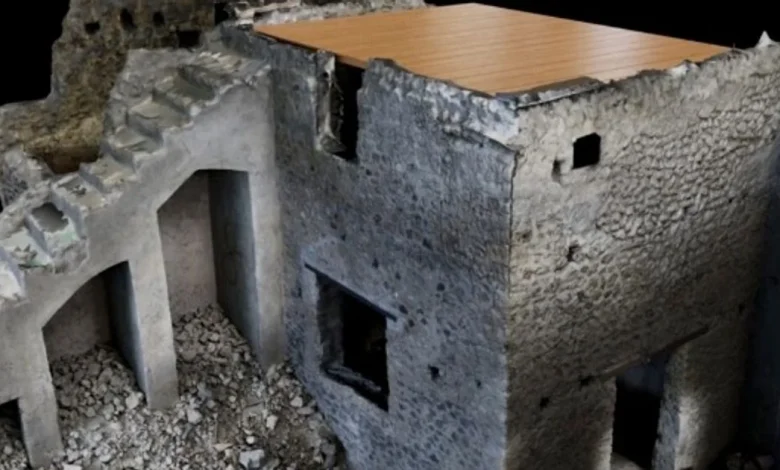
In a ground-breaking archaeological dig, researchers uncovered a grand staircase in pompeii that opens onto what teams describe as a ‘lost Pompeii’ of upper floors and towers that housed the Roman elite. The excavation inside the House of Thiasus revealed a monumental external staircase previously believed to lead nowhere, and digital archaeology has now connected it to multi-storey living. Berlin’s Humboldt University researchers and the director of the Archaeological Park of Pompeii say the finds reshape how the city’s vertical architecture is understood.
Pompeii: Staircase, towers and digital reconstructions
Excavators found a monumental external staircase in the House of Thiasus that, until now, was seen as a dead end; researchers reconstructed its purpose using non-invasive methods and 3D models. Working from clues such as unconnected staircases and cut-off support beams, the team from Berlin’s Humboldt University digitally designed a model showing that the staircase led to an upper floor and to a tower that allowed wealthy residents to overlook the city and the Bay of Naples. The reconstructed tower for the House of Thiasus is estimated by the researchers to have risen to a substantial height and to have formed part of a multi-storey residence reserved for an affluent family.
Researchers explained that volcanic ash both buried and preserved the buildings’ lowest levels while obliterating the upper storeys, leaving the taller structures known now as a ‘lost Pompeii’ visible only through indirect evidence. The team published their reconstructions in the E-journal Scavi di Pompei and used cutting-edge digital archaeology to create hypothetical models of villas and towers that no longer survive in situ.
Immediate reactions
Gabriel Zuchtriegal, director of the Archaeological Park of Pompeii, said: “Archaeological research at Pompeii is highly complex. In addition to fieldwork, with excavations that reveal intact contexts of life in the ancient world and new stories to tell about the tragedy of the eruption. There is also non-invasive research, consisting of study and reconstructive hypotheses of what has not been preserved, but which completes our knowledge of the site. “
Researchers from Berlin’s Humboldt University wrote: “The interior of the lower part was simple in its furnishing. This contrasted by the monumental external staircase that leads to the upper floor, suggesting a living space of a more elegant and representative character. ” The team added: “By putting together the data in the form of a 3D digital model, we can develop hypothetical reconstructions that help us to understand the experience, the spaces, and the society of the time. ” These statements frame the staircase as a key to upper-story urban life that is otherwise lost.
What’s next
Fieldwork and further non-invasive analysis are expected to continue as researchers refine the digital reconstructions and test hypotheses about towers, viewing platforms and multi-storey elite housing in pompeii. Teams will use the models published in the E-journal Scavi di Pompei to guide targeted excavations and to explore how upper floors shaped social life, power and visibility in the ancient city.
The discovery of the staircase reframes what remains under the ash and suggests that completing the picture of the lost upper city will rely on a combination of excavation, digital modelling and careful interpretation of the physical clues left behind by the eruption of Mount Vesuvius in 79 C. E., and it keeps the story of pompeii very much alive.