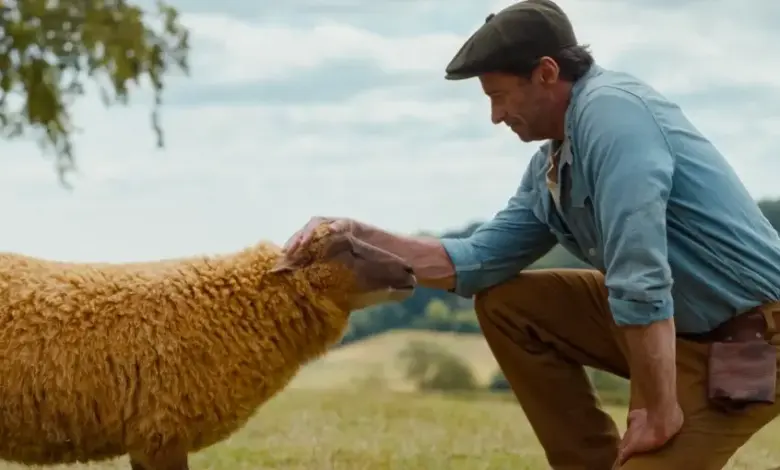
Sheep detectives sounds like a joke title at first, but the film behind it is trying something stranger and more specific: a family-friendly murder mystery built around talking sheep, a shepherd with a personal bond to his flock, and a village where even the sunshine looks slightly unreal. What makes the idea work is not just the novelty. It is the film’s decision to treat its absurd premise with enough sincerity to turn it into a sweet-natured comedy rather than a parody. That balance is the real story.
Why this cosy crime caper stands out
The central appeal of sheep detectives is that it joins two modes that do not usually share the same field: pastoral family entertainment and murder-mystery plotting. The film adapts Leonie Swann’s bestselling book Three Bags Full, with Craig Mazin writing and Kyle Balda directing. The setup is simple but unusual. Hugh Jackman plays George Hardy, a shepherd who lives in an American-looking trailer in the English village of Denbrook and reads detective stories to his sheep every night. The flock understands English, even if it cannot speak it, and that becomes the engine for the investigation.
The result is described as a film that moves briskly past the death at its centre and into the mechanics of clue-hunting. That pacing matters. Instead of dwelling on grief, the story treats the murder as the trigger for an eccentric communal mystery. For family audiences, that is a delicate commercial calculation: enough jeopardy to create stakes, but enough lightness to keep younger viewers engaged. In that sense, the film is less interested in realism than in tone control.
The village mystery and the mechanics of the plot
Denbrook is not presented as a neutral backdrop. It is a place shaped by pressure, including local agribusiness interests that want George’s land and a community that is already uneasy before the murder takes place. George’s flock is unusual even before it begins solving crime: he cares for the sheep for their wool rather than their meat, douses them with blue medicine of his own invention, and seems to have built a private language of trust with them. That relationship becomes the emotional centre of the story.
When the murder happens, suspicion falls on visiting American Rebecca Hampstead, while a nosy journalist and a local copper add to the uncertainty. The plot then shifts toward the sheep themselves, who are the only ones able to properly piece together what is happening. Their detective work is not just a gag. It gives the film a distinctive point of view: the powerless creatures become the most perceptive observers in the village. That is where sheep detectives becomes more than a catchy title; it becomes the film’s organising idea.
Performances, voices, and a deliberately odd tone
Hugh Jackman’s George is the human anchor, but the flock supplies the film’s personality. Lily, voiced by Julia Louis-Dreyfus, is the sharpest of the sheep; Mopple, voiced by Chris O’Dowd, adds patience; Sir Richfield, voiced by Patrick Stewart, brings a stately air; and Sebastian, voiced by Bryan Cranston, is described as self-doubting and shaped by an unhappy past. The human cast adds texture too, including Nicholas Braun as the local copper, Conleth Hill as the butcher, Tosin Cole as a rival farmer, Hong Chau as the postmistress, Molly Gordon as Rebecca Hampstead, Nicholas Galitzine as the journalist, and Emma Thompson in a spiky cameo as the lawyer.
The film’s tone is openly whimsical, but it is not empty. The sheep are not simply cute decoration. They are written as characters with their own internal politics, fears, and growing courage. One of the more interesting aspects is that their investigation seems to mirror George’s habit of teaching them through stories. In other words, the film suggests that narrative itself can be a tool for survival, not just amusement.
What the film says about family entertainment now
Sheep detectives arrives at a moment when live-action family films are described as increasingly rare, with much of the market leaning toward animation. That makes this project notable not only as a curiosity but as a commercial experiment. It tries to satisfy children with talking animals while giving adults a murder mystery that can still play as a proper puzzle. The comparison points are obvious, but the film seems more interested in combining comfort with oddity than in chasing a single template.
There is also a broader cultural layer in the film’s use of digital animal characters. The technology is said to be next-level, yet the story still asks viewers to accept a world where sheep can solve a crime but humans often miss the obvious. That inversion is what gives the film its charm and its comic bite. It turns hierarchy upside down without becoming cynical about it.
Sheep detectives and the bigger picture
The broader significance of sheep detectives lies in how it reframes the cosy-crime idea for families. Instead of using wit to distance the audience from violence, it uses tenderness to soften the shock while keeping the mystery intact. That is a narrow path to walk, and the film appears to manage it by making the flock emotionally central without losing the procedural fun of the investigation. The release timing, listed for 7 May in Australia and 8 May in the UK and US, also positions it as a cross-market family title with unusual appeal.
In the end, the film’s real question is not whether sheep can solve a murder. It is whether audiences are ready for a family movie that treats absurdity as a virtue and empathy as a form of detective work. If that combination lands, what other familiar genres could be rewritten from the point of view of the unlikely observer?