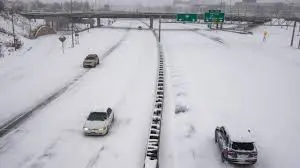
Spring has not arrived on schedule for the West. A new snow advisory from the National Weather Service warns that Colorado, Montana, and Wyoming could still see heavy accumulations over the weekend and into early next week, with some locations facing as much as 24 inches and winds up to 45 mph. The message is simple: snow remains the dominant risk even as the calendar turns.
What is the National Weather Service warning that the public should focus on?
Verified fact: The National Weather Service issued a winter weather advisory for three states. an upper-level energy moving onshore over California on Saturday will shift to the Upper Midwest by Monday evening, and that the system will produce rain with embedded thunderstorms over parts of Northern California and Nevada on Saturday and Sunday. It also said the same system will bring late-season light snowfall over the higher elevations of the Northern Rockies, the Northern Intermountain Region, the Sierra Nevada Mountains, the Great Basin, and the Central Rockies from Saturday into Sunday.
Verified fact: The agency is calling for heavy snow in Colorado, Montana, and Wyoming as a cold front moves through the Northern Rockies. In Wyoming, the Cheyenne office issued a heavy snow warning for the Sierra Madre Range and Snowy Range, including Albany and Centennial, where 12 inches of heavy, wet snow is expected. Battle Pass is forecast to see the highest totals in the state, with up to 24 inches possible.
Why does this snow advisory matter beyond the headline number?
Verified fact: Colorado faces a similar setup. The Grand Junction office listed Skyway, Crested Butte, Taylor Park, Marble, Monarch Pass, McClure Pass, Buford, Trappers Lake, Silverton, Molas Pass, Coal Bank Pass, Rico, and Hesperus in its warning area. Those locations could see up to 12 inches of snow and winds reaching 45 mph. Grand Mesa is expected to see the most snowfall in the state, with up to 24 inches of accumulation possible.
Verified fact: Montana is expected to see lighter totals than in recent days, but the state is still under winter weather conditions through Sunday morning. The forecast calls for six more inches of accumulation, and the advisory is expected to end on Sunday at noon. That timing matters because the system is not a brief burst; it is spreading risk across multiple elevations and multiple days.
Analysis: The contradiction is obvious. The season says spring, but the weather setup says winter. The result is not just inconvenience; it is a layered hazard in which heavy wet snow, mountain terrain, and strong winds can combine to make travel slower and more dangerous than a simple snowfall total suggests. In this snow event, totals are only part of the story. The timing, elevation, and wind exposure are equally important.
Who is most exposed, and what does the warning signal about conditions?
Verified fact: The warning spans mountain ranges and high-elevation corridors rather than broad urban areas. That indicates the greatest impact is concentrated in places where snowfall can pile up quickly and where road conditions can change fast. Wyoming’s Sierra Madre Range and Snowy Range, Colorado’s mountain passes, and Grand Mesa all sit in the highest-risk category named in the advisory.
Analysis: The phrase “heavy, wet” snow is significant because it suggests a more burdensome type of accumulation than light powder. When paired with 45 mph winds in Colorado, the advisory points to reduced visibility and more difficult conditions for anyone moving through higher terrain. The fact that Montana’s advisory is set to expire by Sunday noon also shows the weather pattern is uneven: some states face a shorter window, while others could be dealing with deeper totals into early next week.
What should readers take away from the state-by-state picture?
Verified fact: Colorado and Wyoming appear positioned for the most severe impacts in this advisory, with 24 inches possible in Grand Mesa and Battle Pass. Montana is expected to receive less snow than earlier in the week, but still enough to keep the advisory in place through Sunday morning. The National Weather Service also tied the broader system to rain and thunderstorms farther west, underscoring that one weather pattern is producing very different outcomes across the region.
Analysis: The larger issue is not just accumulation; it is how quickly late-season systems can still overwhelm mountain travel and planning. For readers tracking this snow event, the key fact is that the threat is not fading simply because the calendar suggests it should. The advisory shows that winter remains active in the high country, and the combination of snow, elevation, and wind is enough to keep the risk elevated until the system moves on. For anyone in the affected zones, the snow warning is not symbolic — it is a clear signal that conditions can deteriorate fast before the weekend ends.