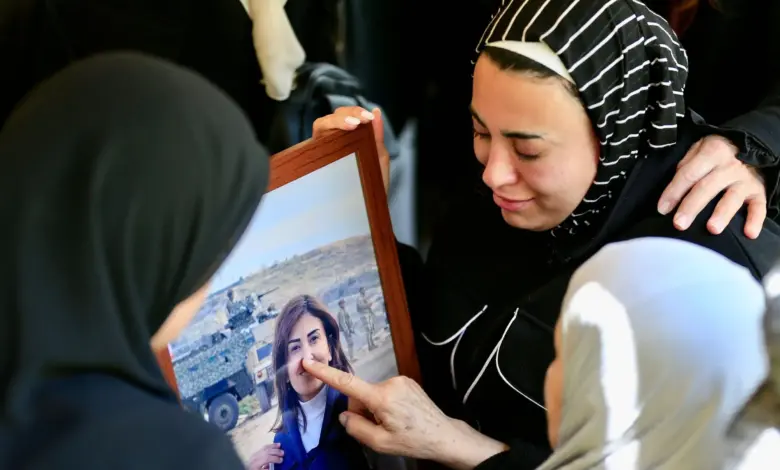
At the cemetery in Baïssarieh, in southern Lebanon, a coffin draped in the Lebanese flag moved slowly through a crowd throwing rice and flower petals. On top of it sat a helmet and a bulletproof vest. The scene gave the word journaliste a painful weight, as family members, friends, and colleagues gathered to honor Amal Khalil, who was killed in a strike the day before.
What happened in Baïssarieh?
Nearly 2, 000 people came from across Lebanon to say farewell to Amal Khalil, 42, who worked as a journalist for Al-Akhbar. Her funeral became more than a private goodbye. It became a public moment of mourning, anger, and fear, shaped by the same violence that had defined much of her work in the south.
Her sister-in-law cried out for her not to leave. Another close relative shouted that her pen would never die. Around them, the atmosphere was pierced by the sound of a distant explosion, a reminder that the war had not ended for those gathered there. In that moment, journaliste was not an abstract profession. It was a daily risk carried into the field, then brought back to the graveside.
Why did her death resonate so widely?
Amal Khalil was not only remembered as a victim. She was remembered as a reporter who covered the south of Lebanon for years, through repeated rounds of conflict and destruction. Her work placed her in the villages and along the front lines where civilians were living with the consequences of the fighting. She had become, in the words used by mourners, the “voice” of southern Lebanon.
The circumstances of her death added to the outrage. She and her colleague Zeinab Faraj had taken shelter in a house in Al-Tiri after an initial strike hit a vehicle in front of them. A second strike hit the house where they had sought refuge. Lebanese authorities said it took hours before rescuers could reach the site and recover Khalil’s body from the rubble. The Israeli military said it had targeted two vehicles carrying fighters and denied blocking rescue teams. Those accounts remain in conflict.
The funeral also echoed a larger concern that has grown around the safety of reporters in the region. The Committee to Protect Journalists has recorded at least 11 Lebanese journalists and media workers killed by Israel since 2023. That number gave mourners a broader frame for their grief: this was not only one death, but part of a pattern that many now see as unacceptable.
What did colleagues and officials say?
Shahnaz Ghayad, a longtime friend of Amal Khalil, called the killing a war crime and asked why journalists should not be protected under international humanitarian law and the Geneva Convention. Her words carried the frustration of people who believe the basic rules meant to shield civilian reporters are failing in practice.
Lebanese President Joseph Aoun and Prime Minister Nawaf Salam denounced the killing as a war crime and said they would bring the matter before international institutions. António Guterres, Secretary-General of the United Nations, condemned what he described as violations of international humanitarian law. Reporters Without Borders and Human Rights Watch have called for an independent investigation.
There were also signs that Amal Khalil had understood the danger long before her death. She had received three direct threats from Israeli numbers, and in 2024 she described a call telling her to leave the south or face destruction of her home and being beheaded. That detail, repeated in mourning, sharpened the sense that her risk had been known and that her work had continued anyway.
What does Amal Khalil leave behind?
Her funeral closed with the image that opened it: helmet, vest, flag, and a coffin carried by dozens of hands. It was a final public testimony to a journalist who kept working in a place where the line between bearing witness and becoming a target had grown dangerously thin. For those in Baïssarieh, the question remains whether her death will lead to stronger protection for journaliste working in conflict zones, or whether the next reporter will face the same road to the cemetery.