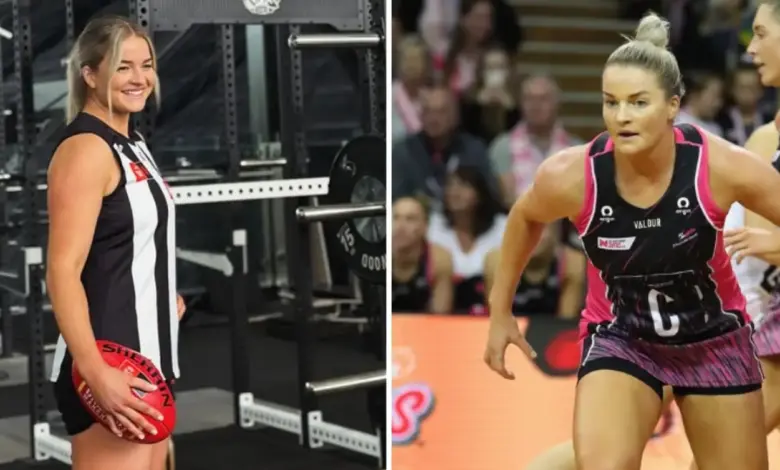
Thunderbirds sits at the center of Maisie Nankivell’s account of how a promising career in netball tipped into a painful struggle with food, weight and self-image. The former Thunderbirds and Melbourne Mavericks star says a comment made during her playing days helped set off years of compulsive thinking that still lingers today.
What did Maisie Nankivell say happened at Thunderbirds?
Nankivell, now 26, spoke in a sit-down interview with Kelsey Browne for SEN’s Centre Court about her road to recovery and why she wanted to use her voice to help others who might relate. She said the problem began while she was coming through the ranks and playing at Thunderbirds, where remarks made to her caused her to question herself.
She described being in good form at the time, moving freely and registering some of her best results, before classic skinfold tests led to a conversation that changed how she viewed her body. She said she was pulled aside at training and left feeling overwhelmed, then went out to train while holding back tears.
That moment, she said, triggered a dark spiral. She began second-guessing what she was eating, restricted herself, and fell into what she called a really bad relationship with food. For Nankivell, the pressure was not only physical. It was tied to the weight of trying to impress coaches she respected and wanted to satisfy.
Why does this story matter beyond one athlete?
The Thunderbirds part of her story matters because it reflects a wider tension in high-performance sport: the line between monitoring performance and creating an environment that can damage confidence. Nankivell said the skinfold tests were “thankfully optional now, ” a detail that underlines how the practice sat inside a culture she found confronting.
Her account is also a reminder that words from authority figures can carry lasting force. She said she used to feel little concern about what others thought, but hearing it from a coach changed that. What followed was not a short-lived dip, but a period she said lasted three or four years and shaped how she saw herself.
The human cost was simple to understand and hard to ignore: she was training every day, sometimes in triple-session and double-session blocks, while believing that training more and eating less would bring approval. Instead, it deepened the spiral.
How is Nankivell describing recovery now?
Nankivell said moving to the Melbourne Mavericks felt like a fresh start and a chance to leave an environment she felt was toxic for her. She said she felt valued there, and that change helped her begin to rebuild. Even so, she was clear that recovery is not a clean break.
She said she still questions what she looks like and still has days when she feels low about herself. But she also said she has come a long way from that dark period, and that speaking publicly is part of how she wants to help anyone who may be struggling in a similar way.
Her comments sit alongside a broader effort involving EDV Victoria, EDV and Henley, who have partnered with the Melbourne Mavericks to raise awareness, promote positive body image, encourage healthy relationships with food, and support those affected by eating disorders.
What response is being built around stories like this?
The response in Nankivell’s case is not framed as a single fix. It is a mix of awareness, support and a push for healthier attitudes inside sport. That includes recognising that skinfold tests can become part of a harmful pattern when combined with pressure, scrutiny and the fear of losing a place.
Her story also lands with a wider lesson for coaches, teammates and clubs: performance conversations can shape more than results. They can affect how an athlete eats, thinks and sees themselves long after the training session ends. Nankivell said the spiral was never-ending, and that she lost who she was trying so hard to impress others.
On days when training is done and the body is quiet, that memory still remains. But the meaning of Thunderbirds in her story is no longer only about where the spiral began. It is also about what happens when an athlete finally names it, and when that honesty is used to make the next player feel less alone.
Image alt: Thunderbirds and the body image spiral that followed a toxic test culture